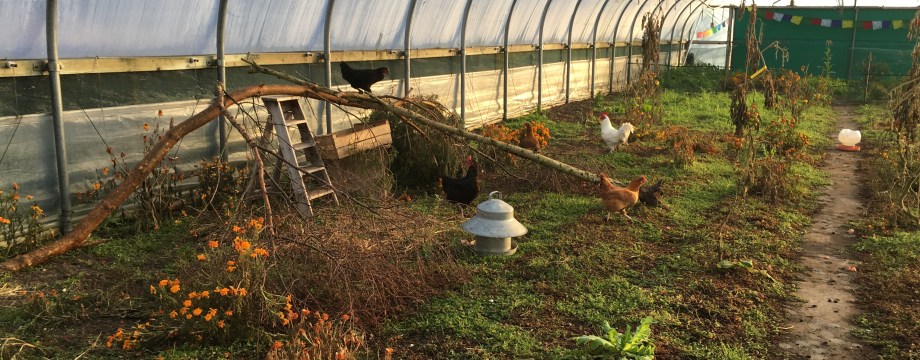
Remember the blog post I wrote back in November about the Montessori school at Arterra Bizimodu in Spain? I heard about that project from a friend of mine, Ethan, whose job sends him all over Europe and Asia (and sometimes South America and Africa too) helping communities called “Ecovillages” to grow and develop (I’ll explain more about ecovillages below). Ethan spends about a third of the year at one of the more famous of these communities, called the Findhorn Ecovillage in the North of Scotland. Findhorn is home to over 450 residents as well as dozens of community businesses and several non-profit organizations. It hosts workshops, speakers, and visitors from around the world.


The organization Ethan works for is called the “Global Ecovillage Network” (GEN). “Ecovillage” is a newish term used to describe a community that makes a special effort to live in harmony with nature and minimize its “ecological footprint.” What’s an ecological footprint you ask? In a nutshell, it’s the share of Earth’s resources we use to support our lifestyle. If you’re curious what your own Ecological Footprint might look like, play this quick game!
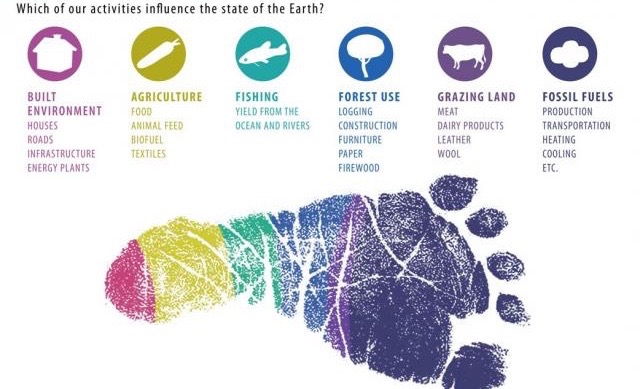
Some of the components of an “ecological footprint.” (Image borrowed from this post)
The residents of ecovillages around the world work together to reduce their impact on the Earth in many creative ways ranging from the way they design their homes and produce energy to how they grow food and share tasks, like cooking. At Findhorn, many of the residents eat together. The communal kitchen serves breakfast, lunch and dinner and feeds more than 250 people a day!
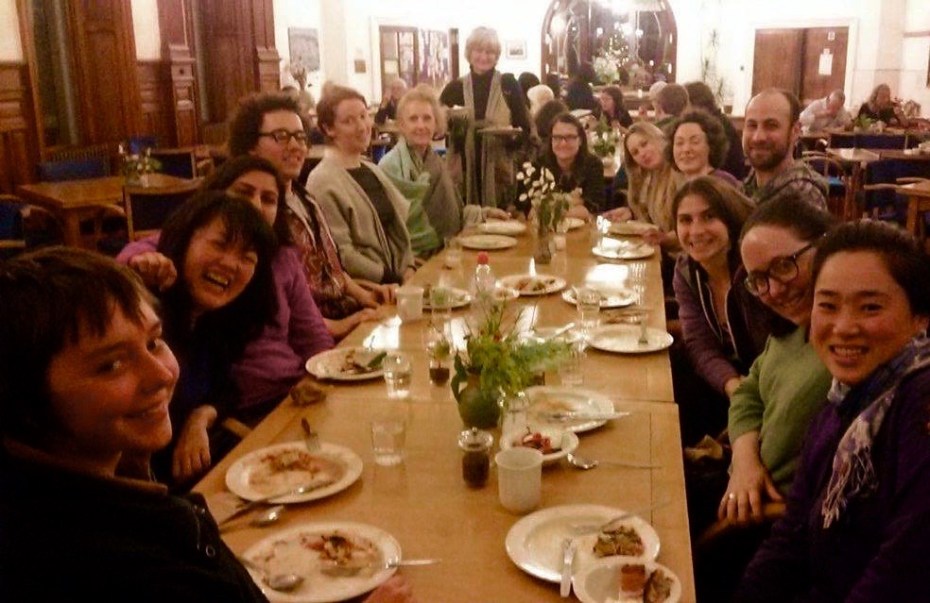
David and I with our “Experience Week” group. Because so many visitors are interested in learning from Findhorn’s example, you need to apply and be accepted into a special week-long program for visitors.
From Dublin, David and I flew into a town called Inverness, took a public bus to Forres, and then another bus to the Findhorn Foundation. Ethan met us at the bus stop and we got to hang out with him and his friends for a night before we headed to “Cluny” the next day– Findhorn Foundation’s other “campus” another short bus ride away.


Some people call Cluny, “Cluny College” because it plays host to the weekly visitors from around the world who come to take part in Experience Week, a introduction to the Findhorn Foundation that’s required if you want to participate in other workshops or programs there or ever live or work at Findhorn. Ethan, Benyamin, and Pavi (above) had all participated in it. Ethan had recommended it to me and David, so we’d applied for scholarships to attend and been granted them!


So we go to Cluny College for the week! Our group of 16 is from France, Sweden, Scotland, England, Japan, Canada, Denmark, and the US. We’re all assigned our own hotel-like room, and we have a non-stop schedule from 8 in the morning until 8pm at night or even later. We “attune” to our volunteer tasks for the week, which means instead of requesting our jobs, we walk around a room full of blank pieces of paper until one calls to us and then we go stand on it. Once everyone’s picked a paper to stand on, we turn them over and read our jobs. This system means I could have been making beds and cleaning bathrooms all week, but luckily my “attuning” powers knew I liked to be outside, and I’d picked a piece of paper that put me in the Cluny Gardens:


David worked in the Cullerne Gardens and specifically excelled at making a delicious compost mixture of food scraps, manure, straw, and egg cartons:


Other entertainment throughout the week included lectures from people who live in Cluny, group dances, singing and games. There was also a lot of sitting in circles and talking. Hey, did you know in the United Kingdom there’s no such thing as the “hokey pokey”? Nope, it’s called the “Hokey Cokey” and the song’s a bit different too, including this little portion: “Knees bent, Arms stretched, Rah Rah Rah”(click on this Hokey Cokey link to hear the full song) One afternoon we go to the Findhorn River and take a beautiful hike to a snowy beach:


On the last night we enjoyed delicious vegetarian Haggis (the vegetarian part is key because this traditional Scottish dish would otherwise include sheep’s heart, liver and lungs!) with “Neeps and Taties” (mashed turnips and potatoes).
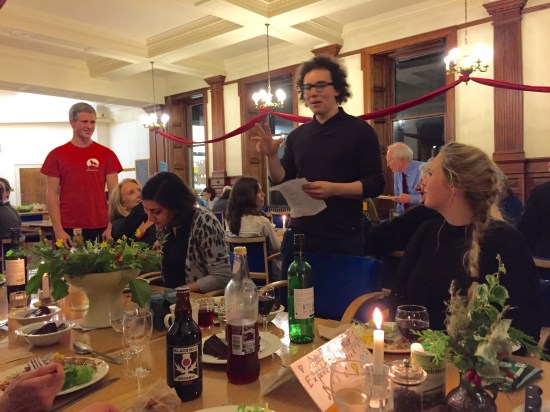
At the end of the week, we said goodbye to our new friends and went back to stay with Ethan for a few more days.


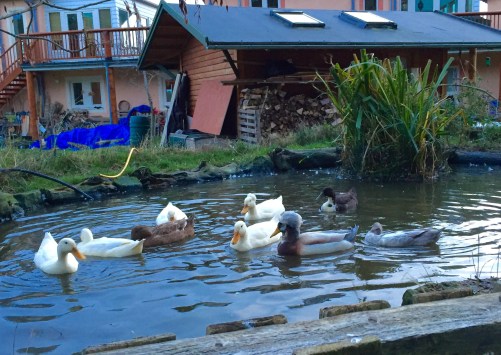
Ethan’s backyard neighbors. Check out that hair!
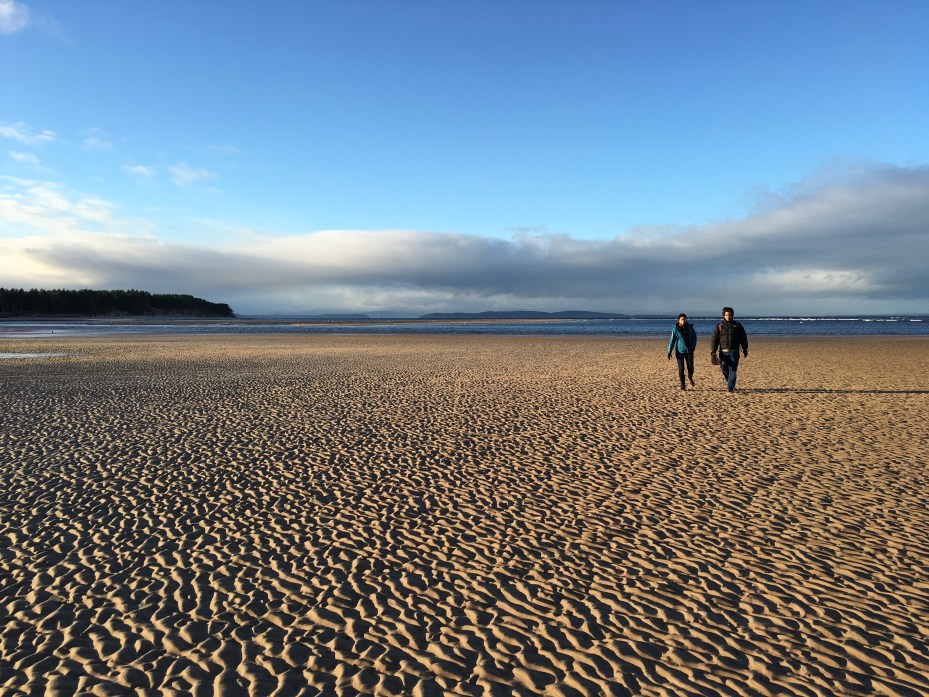
The beach in the town of Findhorn, Scotland about a 15 minute bike ride away.
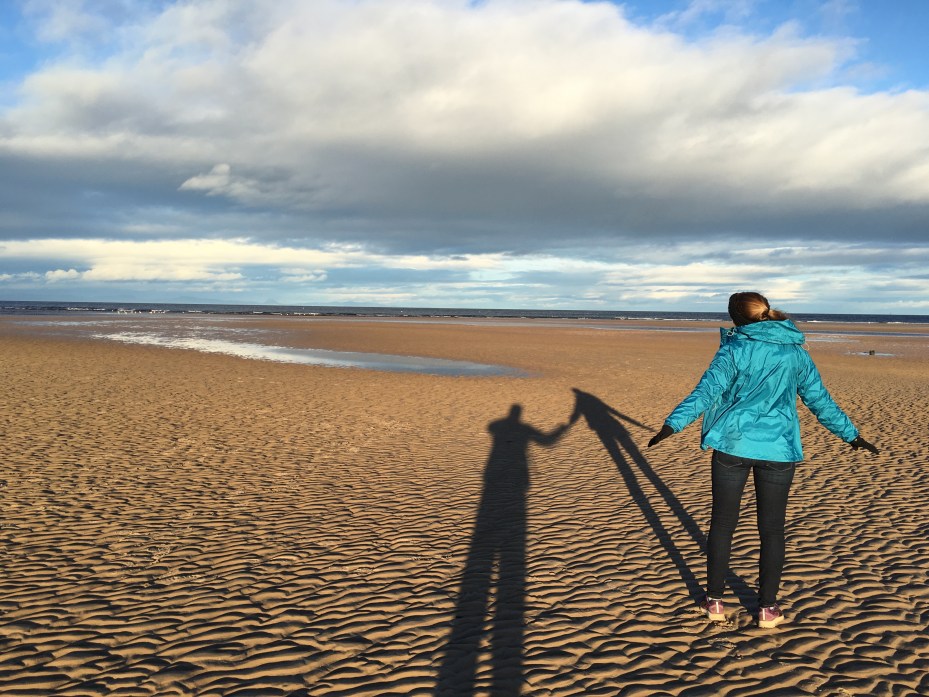
Shadow handshake
Before leaving Scotland, we took a road trip down to the capital, Edinburgh, with another new friend, Katie, who Ethan had introduced us to the night before.


In Edinburgh, we stayed across the street from a lively Holiday market.


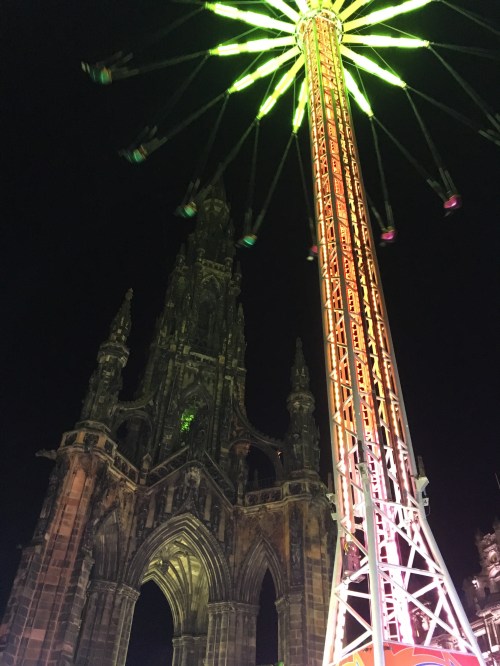
We made the most of our one full day in Edinburgh by taking another Free Walking Tour like we’d done in Amsterdam. This time our tour guide’s name was Johnny and we learned all kinds of random facts from him including: 1) Edinburgh has a building that’s the tallest monument in the world to a writer (Sir Walter Scott- he wrote Ivanhoe among other books). 2) The unicorn is the national “animal” of Scotland. 3) A couple hundred years ago Scotland decided to brand itself as the “Athens of the West” and invited an architect to make their city more Greek and Roman. Cue statues such as Alexander the Great (who never came to Scotland, let alone knew the United Kingdom existed) and the statue of Scottish philosopher David Hume wearing a toga and sandals (an outfit he never wore) to make him look more “Greek.” 4) A fun fact about the heart below, which is found in front of St. Giles’ Cathedral: Several foreigners have found it romantic to propose in the heart; HOWEVER this marks the location where the tax office used to be and everyone else spits in the heart for good luck, so maybe not the best choice for a spot to get down on one knee.


Johnny also explained to us that Edinburgh’s “Cathedral” is actually a church since in recent Scottish history (ie after the 1600’s), the Church of Scotland hasn’t had bishops or dioceses and thus there haven’t been “cathedrals” in the formal sense. Also the church’s very old-looking stained glass windows were actually installed in the 1990’s. There is, however, a wooden carving of an angel playing the bagpipes, which Johnny challenged us to find and David and I succeeded in doing with the help of a friendly volunteer who let us into the locked Thistle Chapel.


Another interesting fact we learned from Johnny is that 300-years old, Scottish burglar alarms consisted of a “trip step” on your staircase, which was a stair that was slightly taller or shorter than the others so that the burglar would fall making a loud noise that would wake the sleeping owners and thus prevent a burglary.


The last stop on the tour was Greyfriars Kirkyard, a graveyard with not one but two claims to fame. The first involves one of Edinburgh’s most well-known characters: none other than a dog named Bobby. Bobby was the loyal companion to a night watchman named John Gray in the 1860’s. When John Gray died he was buried in Greyfriars Kirkyard, and Bobby is said to have loyally slept by his master’s grave for the next 14 years. When Bobby died in 1872 he was buried in the graveyard as well and a statue was commissioned in his honor.


Greyfriars Kirkyard has enjoyed recent fame because of the fact that JK Rowling used stroll through the graveyard and a few of the names she read on tombstones may have inspired some of the characters’ names in Harry Potter. For example the tomb of poet William McGonagall = “Professor McGonagall.” And the tomb of the unsuspecting “Thomas Riddell Esquire” now receives all sorts of fan (and hate) mail for being the true name of Rowling’s villain, Voldemort.
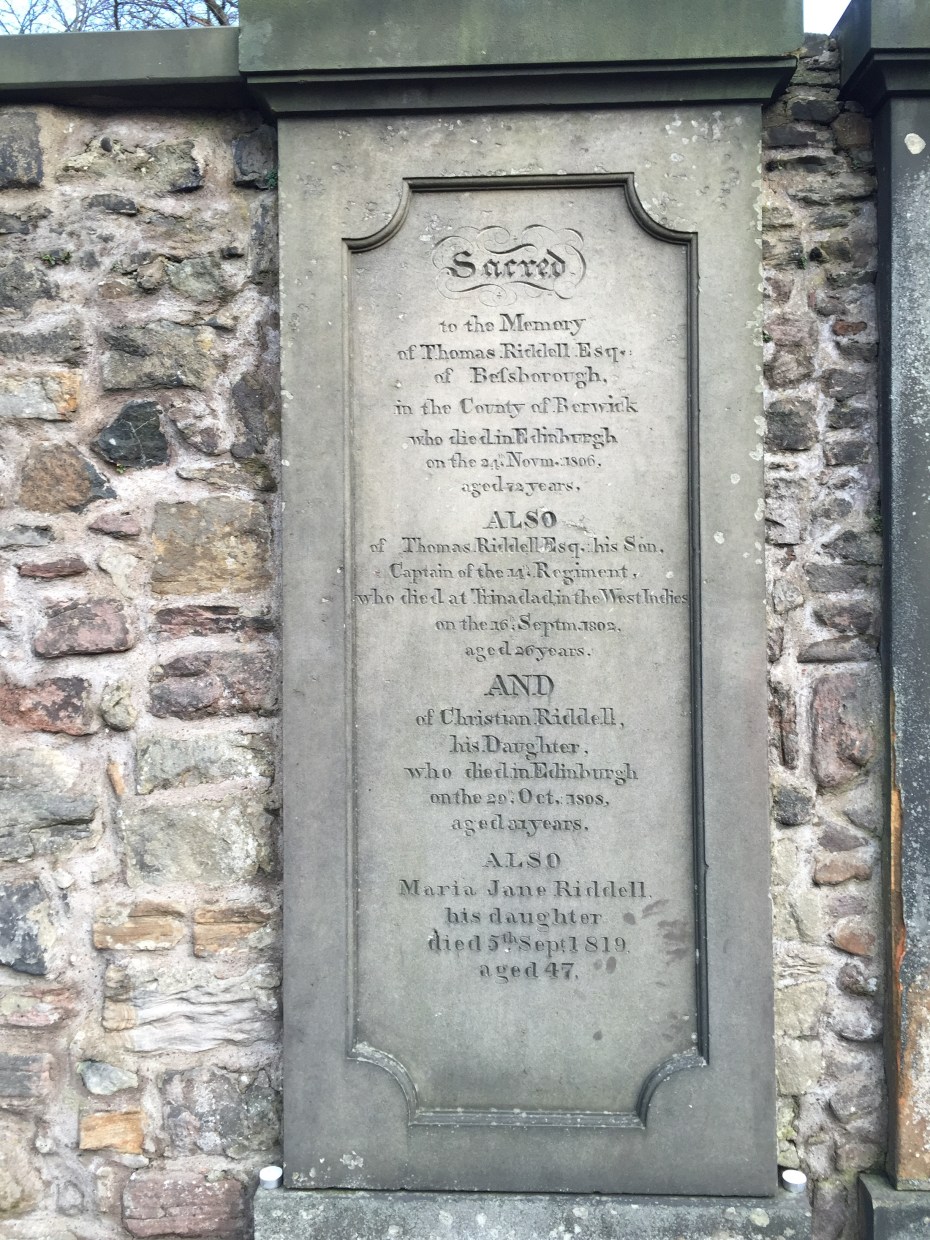
Gravestone of Thomas Riddell
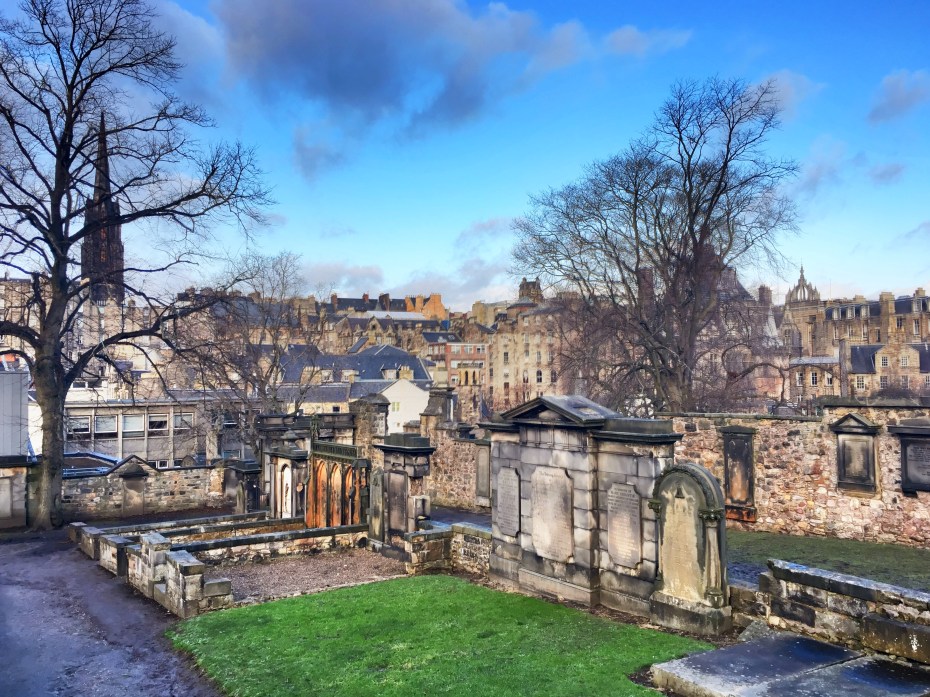
Greyfriars Kirkyard
One more tidbit for Harry Potter fans: behind the graveyard is the Elephant House Cafe, where JK Rowling wrote the 3rd and 4th Harry Potter books (do you know what the titles are?) The bathrooms at the Cafe, which are covered in fan writings about the books and their characters, have become a tourist attraction in and of themselves (I guess this is one instance in which graffiti is welcomed- as long as it’s on topic!):


After the tour, we saw a few more scenic scenes of Edinburgh on our own that afternoon and evening:


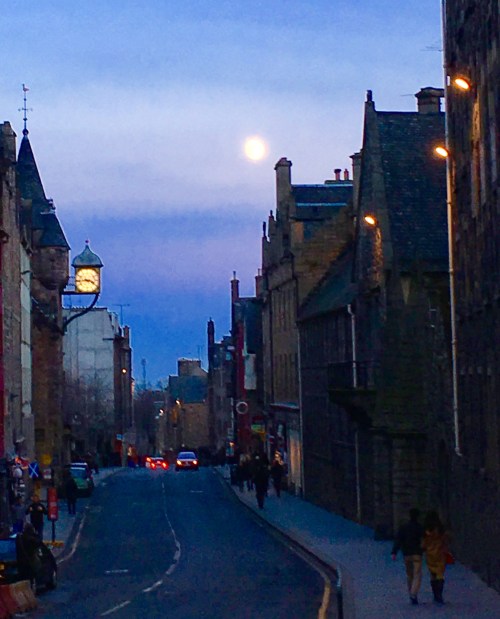
This time tomorrow we’ll be heading back to where we started this whole journey: España!
 handshakehighfivehug