Author Archives: dhardoon

Monkeys and Fairies and Penguins, oh my!

Our next stop is a place called “Nature’s Valley,” one of the jumping off points for visiting Tsitzikamma National Park. We stay at an AirBnb with Joy, her two dogs Tina and Guardy, and her rabbit, Peter.

IMG_8846

“Blue Skies and Butterflies,” Joy’s AirBnb, is my favorite color

We arrive with time to stop by the neighboring farm stand before it closes (we buy homemade Peri Peri sauce among other delicacies- a delicious South African Spicy Sauce) then head to the beach for a sundowner swim.

IMG_8853

As you can see, people have visited (the farm stand in) Nature’s Valley from all over the world! And left their country’s currency behind.

That night there is another couple, Alex and Amanda from Canada, staying at “Blue Skies and Butterflies.” They already had reservations for kayaking at Storms River Mouth in Tsitzikamma National Park, so we follow them there in the morning. We run into Marco from Germany who was in our group of 4 when we went into the Lemur cage in Oudtshoorn. In addition to kayaking we also take a turn on small inflatable rafts called, “Lilos” and get to splash around in the river and climb up rocks (then jump off!).

All that rock jumping got David warmed up to do this, which one of our kayaking guides showed him when he saw how much he likes to flip off of things:

After our kayaking adventure and some well-deserved lunch, we did a long hike to a waterfall with Alex and Amanda. We had to do a lot of rock hopping and it took us about 2 hours to reach the waterfall, so when we did, the boys jumped right in. Guess I didn’t get sweaty enough, because that water was still too cold to me!

The next day we made a few important stops:

Stop #1… Monkeyland! This is a primate sanctuary in Plettenberg bay where one of the highlights was actually the family of baboons outside of the gates (see the mischievous one trying to get into someone’s car?!)

Looks like these baboons are having a ton of fun monkeying around with each other!

My favorite part of the day: The Monkeyland guide and our group walked on ahead and I stayed behind to film some monkeys play-fighting off in the distance. Just then I heard a rustling close by, and I turned to see one of the sanctuary’s 2 gibbons climbing down out of the tree. She walked right into the middle of the path, sat down, and then turned to look at me. So I walked to the middle of the path, sat down, and looked back at her. For about 2 whole minutes we sat like that. Now 2 minutes might not sound like a long time, but when’s the last time you sat down and looked someone (or animal) in the eyes without speaking for 2 whole minutes? Give it a try! It feels like forever. Later when I showed the guide the picture, she told me I’d met Siam, the sanctuary’s female gibbon, and that it was rare to spot her, let alone have her come down and say hi.

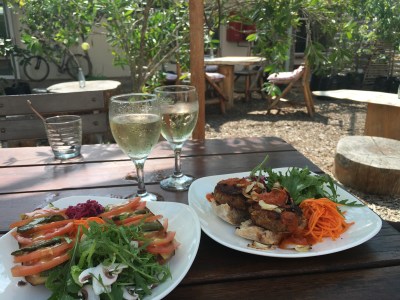
Continuing on, we stopped for lunch at a vegetarian restaurant (one of very few I discovered in South Africa) in Knysna:
IMG_3004

Grain Mill Organic Bistro

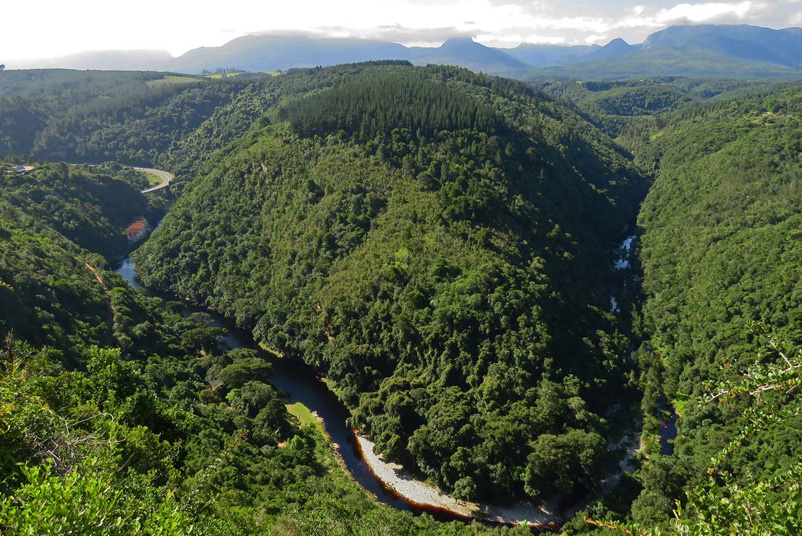
Stop #2 was to see something called, “The map of Africa” in a town called Wilderness. It was really foggy, but we were able to make out the outline of the river, which just happened to make the neighboring hill appear to be in the shape of the African continent.

africa

Since you can’t see as well from our foggy photo, I found a photo on the internet of the “Map of Africa” on a bright, sunny day.

We spent the last night of our Garden Route road trip staying with Emily and Andre’s friends, Chantall and Dehain and their adorable son Micah in the city of George.

Even though we’d never met them, they welcomed us with opens arms (and a vegetarian pot pie). The next day we had to make it back to Stellenbosch for Emily and Andre’s pre-wedding festivities, but we still had time to make a few stops along the way:

#1) Tide pooling and snorkeling at Santos beach in Mossel Bay. David sees an octopus!

#2) Organic Paradise restaurant outside Swellendam:

#3) Fairy Sanctuary, Swellendam. A very interesting experience…

And then we were back in Stellenbosch for the pre-wedding Braai at Gertrude and David’s (I don’t have any photos from it, but I do have this photo of their living room and their adorable pup, Chloe):

The next day, it was wedding time! We made lots of new friends and reunited with “old” ones (Like Chantall and Dehain, hehe)

The fun continued the rest of the week:

At Claudette and Gavin’s, I peel lychees for the first time (above right) !

Monday, Emily toured us, SueAnn, and Marybeth around Cape Town. Our first stop, Kalk Bay:

IMG_9036

Then the famous African penguins of Boulder Beach:

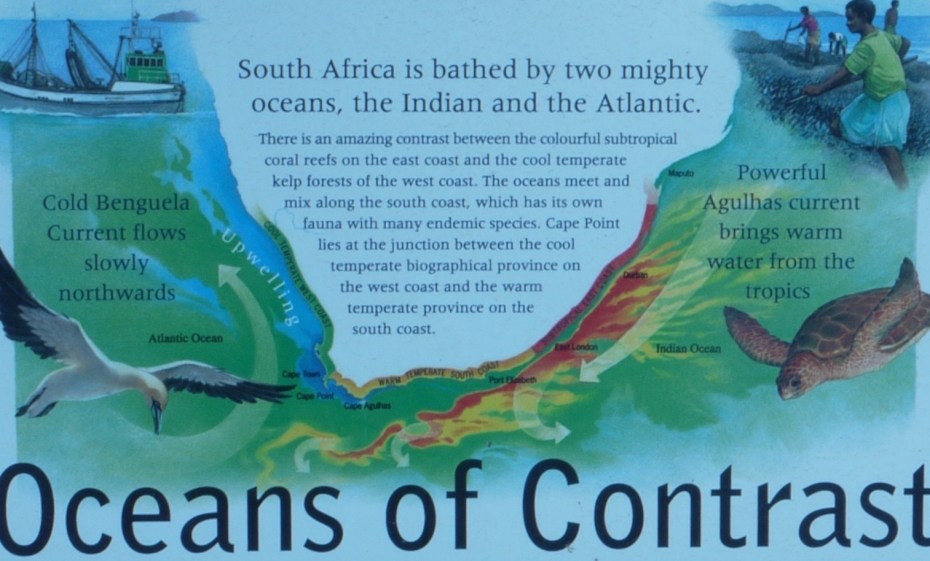
Next stop was Cape Point where you can hike up to a lighthouse with a view of where the Atlantic and Indian oceans meet.
cape-point-1

It’s also full of baboons who were not the least intimidated by people. While we were eating lunch at fancy restaurant there, a baboon snuck in through the side door and made off with the sugar jar before the waiter could chase him out. It happened so quickly, there was no time for a video, but David got a few later that afternoon.

Then we hiked up to the lighthouse where it was VERY windy:

Later we drove closer to the convergence of these two Oceans at a famous lookout called the Cape of Good Hope.

This was followed by a scenic sunset drive past Hout Bay:

And then dinner at the Leopard Lounge at the Twelve Apostles Hotel:

Marybeth and Sue Ann were spoiling me and David right along with Emily, and the next morning took us out for High Tea! My mouth is watering just thinking about all those delicious pastries and savory tea sandwiches:

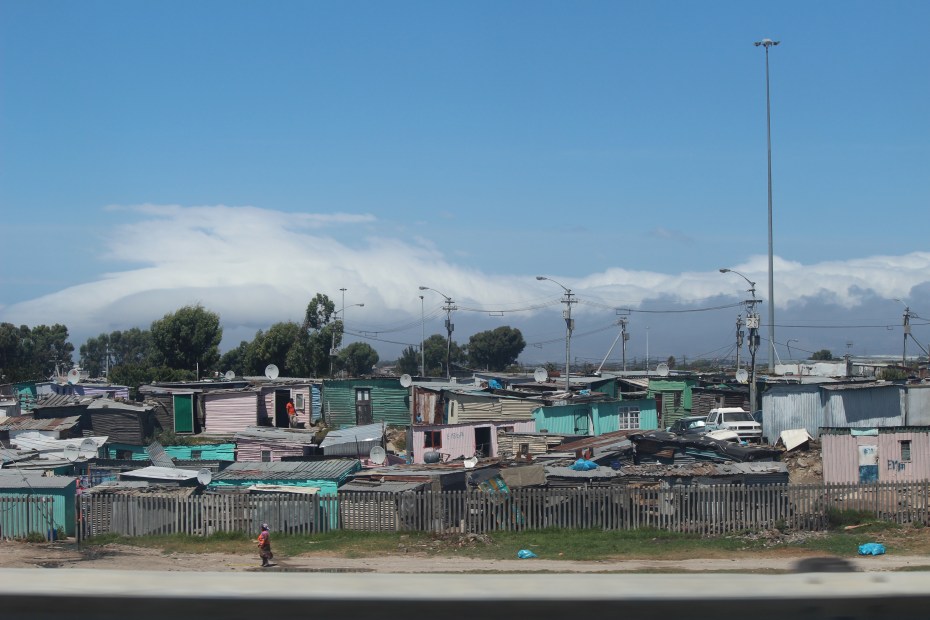
In contrast, the afternoon was somber as we delved into the recent South African history of Apartheid during a tour of Robben Island where Nelson Mandela was imprisoned.

Our tour guide of the prison was an ex-inmate of 7 years who went to Angola for military training in order to join the student resistance to apartheid.
IMG_5150

Older prisoners hit tennis balls with messages in them over the fence to the younger prisoners.

Apartheid was a system in South Africa put in place in 1948 that separated people based on their race and skin color. There were laws that forced white people and black people to live and work apart from each other. The government also took over the schools and forced the segregation of white and black students. Even though there were less white people than black people, the apartheid laws allowed white people to hold all the power and anyone who protested was thrown in jail.

The United Nations and the world began to widely criticize and protest apartheid in the 1970s, and the US greatly cut back on trade with the country by 1985 to pressure them more to end it; however, Apartheid continued until 1994. In 1994, a new election was held in which people of all color could vote. The ANC won the election and Nelson Mandela became president.

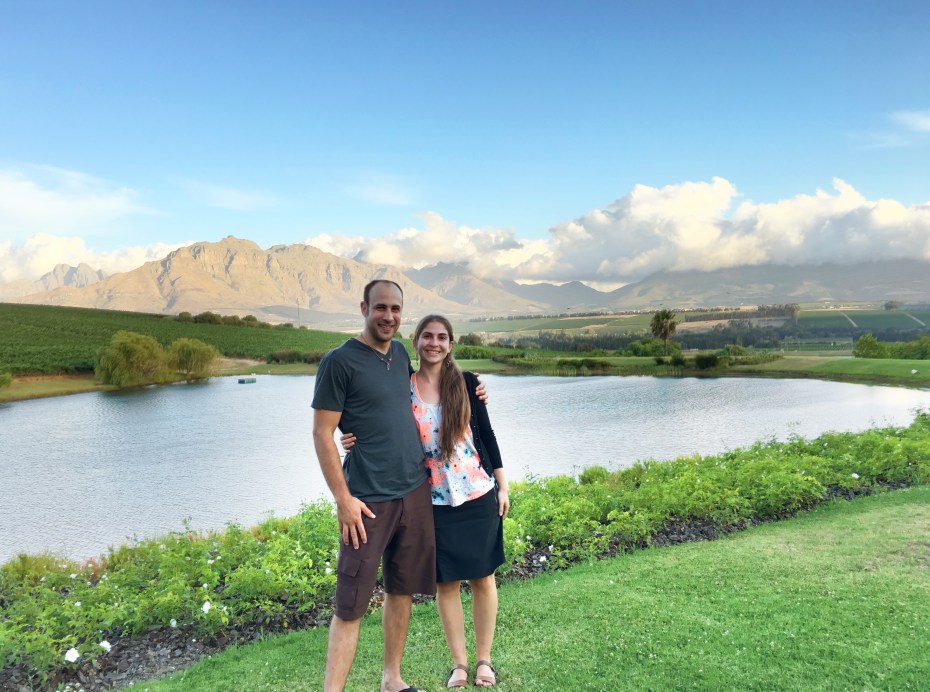
Kirstenbosch Botanical Gardens. We walked the new snake-like canopy bridge, lounged in the grass, David climbs a Ficus Craterostoma (Fig tree), We walk through Fynbos and fragrance gardens.
IMG_3542IMG_3545

Sundown cocktails at Asara with Emily, Andre, Marybeth, Mandy, and Garth.
Categories: Uncategorized | Leave a comment

South African Sunshine

We landed in Cape Town on the morning of December 28th. Unfortunately, because of our tight connection in Switzerland, our bags did not accompany us on the second leg of our  journey. We did a little research, however, and learned that the bright side of only having the shirts on our backs was that our credit card company would reimburse us $100 for clothes every day until our luggage arrived. This fact was a welcome relief because I was wearing pants and sneakers and it was HOT in Cape Town for a couple of reasons:

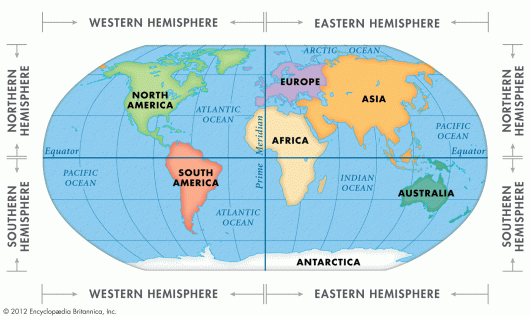
a)  It was SUMMERTIME! See map below.

northern-southern hemisphere

South Africa is in the Southern Hemisphere, which means its seasons are opposite to ours in the US and Europe.

b) Not only was it summer, but Cape Town was experiencing a heat wave, with some of the hottest temperatures on record for December and January.

Our AirBnb host, Daniel, was an architect from Mexico who had lived and worked in Europe and also Asia before coming to Cape Town. He’d been in Cape Town for  3 months and so was happy to walk around and explore with us.

IMG_8179

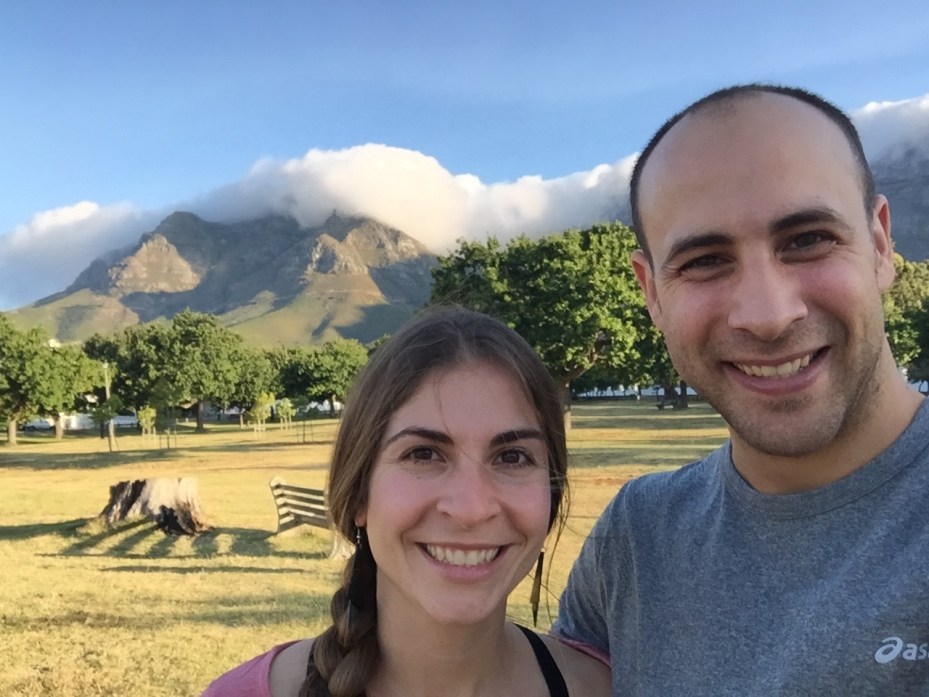
View of the fog rolling in over Table Mountain from a park near Daniel’s house in Cape Town

Daniel’s AirBnb was right near a popular street in Cape Town called “Long Street.” There’s lots of restaurants and shopping on Long Street, which was convenient for David and my need to replace missing items from our luggage. The first things I bought with my “free” money were shorts and flip flops!

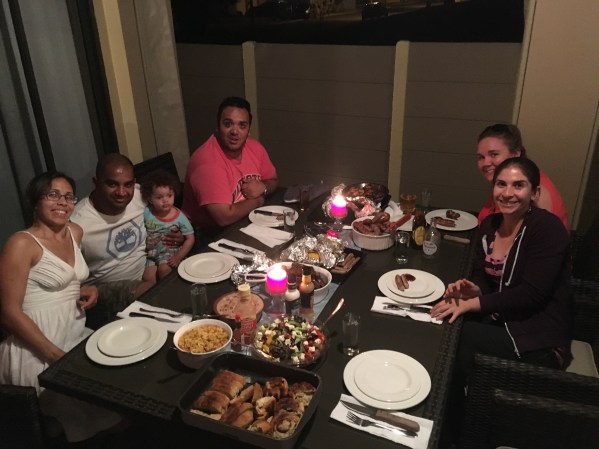
We also shared several meals with Daniel, including our first night when he invited over a group of his friends for a barbecue, which in South Africa is a time-honored tradition and even has a special name: Braai. A lot of Daniel’s friends were architects too and they were from all different parts of South Africa, and England and Germany too.

Some of our first sightseeing adventures in Cape Town included:

Screenshot 2016-07-25 16.14.08

The colorful Bo-Kaap neighborhood in Cape Town

Following the advice of friends we tried out our first hop-on, hop-off sightseeing bus. We didn’t take any photos of the bus, but here’s a couple off the internet so you can get an idea of what our tour was like:

One of my best friends from High School, Emily, now lives in Cape Town because her husband, Andre, is from there. They were both out of town when David and I first arrived, but I had met a few of their friends at Emily and Andre’s wedding in Boston and they generously hosted us instead.

IMG_8269

Reunited with Mandy and Claudette, who I’d met a few months before in Boston

IMG_8264

Sunset and Music at Blue Peters in Blouberg

IMG_8359

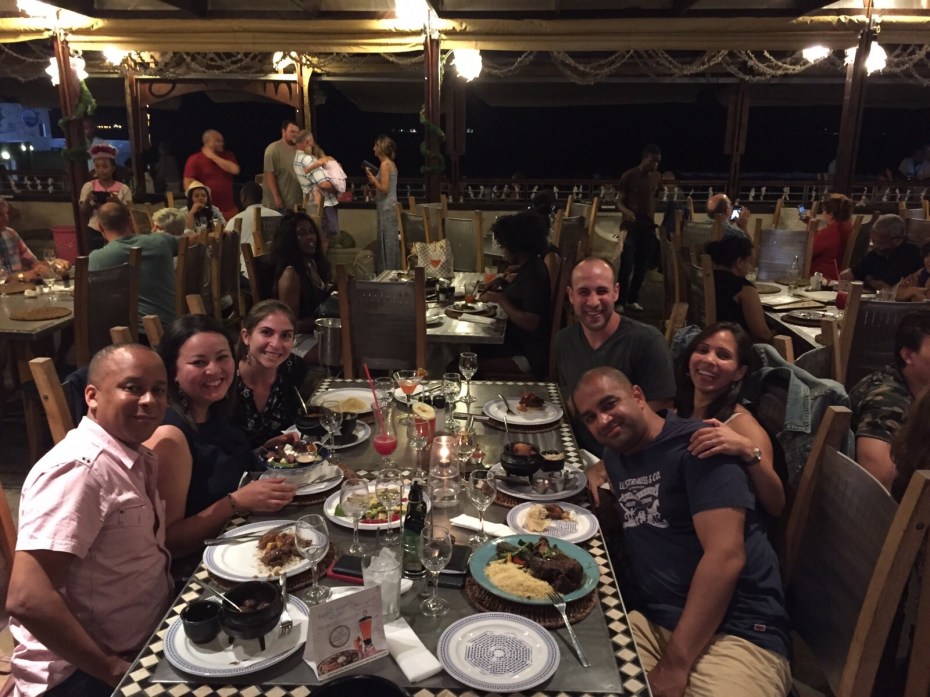
Scrumptious South African food at Moyo with our Cape Town crew: Gavin & Claudette are next to me and Mandy & Garth are next to David.

The next day was already New Year’s Eve, and David and I made a last-minute plan to meet up with Emily and Andre a couple hours north of Cape Town in a town called Langebaan. They were staying with Andre’s parents, but we got the last cottage at a nearby Greek-themed resort called, “Mykonos,” so they moved in with us for the night.

David and I borrowed Andre’s sister’s car because she’s spending the year working in the Netherlands (do you remember which city I went to in the Netherlands?), and luckily she was willing to lend it to us while she was gone. Then we set off for “Greece.” Just outside the resort we stopped to do some food shopping and were serenaded by this band playing up and down the aisles of the Checkers grocery store:

David’s new favorite song = Ala-bama (name of the ship that brought the banjo to South Africa).

On New Year’s day we headed back down toward Cape Town and attended a bangin’ Braai (pronounced “bry” as in rhymes with “fry”) at Mandy and Garth’s. Braai-ing is as important to weekends and special occasions in South Africa as Bbq-ing is in the US. Actually, “braaivleis” means “barbecue” or “roast” in Afrikaans, but the grill itself looks a bit different than the one we’re used to back home:

IMG_2918

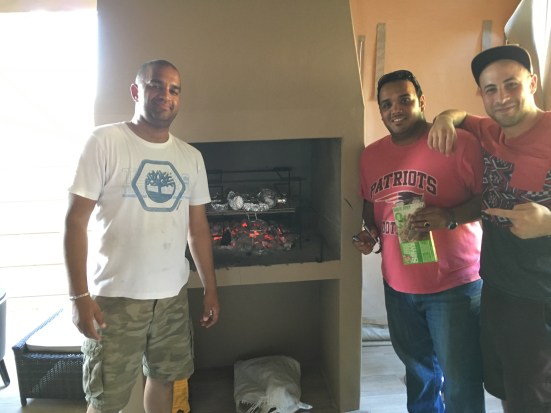
The boys tending the braii

We also got to meet their two adorable kids, Luke and Isabella, who had been staying with their grandparents when we’d all gone out to dinner a few nights before.

IMG_2920

The feast is served!

We loved staying in Mandy and Garth’s gorgeous home and they were such welcoming and generous hosts it really inspired us to want to pay that hospitality forward by being super hosts ourselves in the future (when we have a home!)

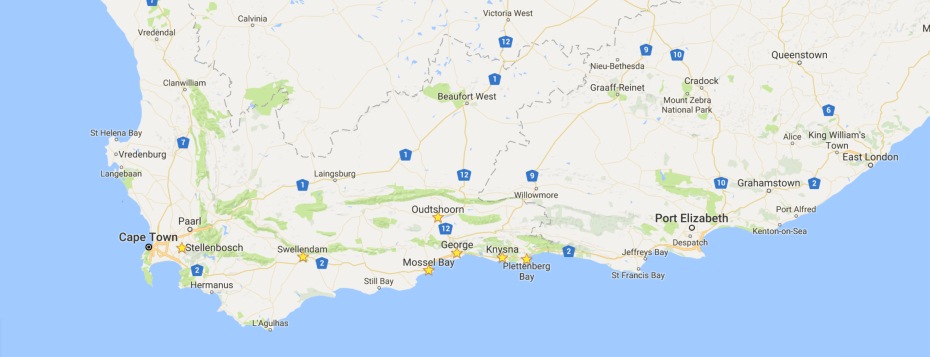
Armed with lots of advice from Mandy, Garth, Claudette, Gavin, Emily, and Andre (and a list of places they love lovingly scrawled on some scrap paper), David and I set off on a 5 day road trip along the Southern Coast of South Africa. Like in Ireland, this well-traveled road trip route has a special name (in Ireland you might remember it was the, “Wild Atlantic Way”). In South Africa it’s called the “Garden Route” and stretches from Mossel Bay to Storm’s River, just past Plettenberg Bay. Some of the places we stopped (and that I’ll post photos of) are starred on the map below:

Screenshot 2016-08-04 16.07.10

A few glimpses of the gorgeous scenery we encountered along our drive:

IMG_2960

Note all those little brown dots on the green lawn are cows.

IMG_2971

We discovered this arch when we veered off our directions just outside of Oudtshoorn

Our first stop was Oudtshoorn, where we stayed at the “Simmer Down” lodge, which was owned and run by Yuan and don’t forget his pet goose, Berta, who he rescued many years ago and who has lived at Simmer Down ever since. Although David and I splashed about in the pool quite a bit, Berta only swims when Yuan gets in. 

IMG_8385

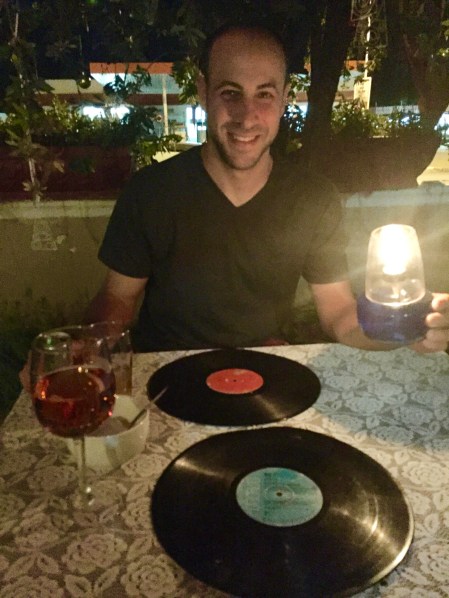
Digging the Vinyl placemats during a dinner at Nostalgie restaurant near our hotel in Oudtshoorn. David is about to try ostrich steak, yikes!

There’s a drive outside of Oudtshoorn called the Swartberg Pass that’s famous for its gorgeous views. Also, it still has the same stone retaining wall built by prisoners in 1888 (how many years old is it?)

We only drove about 30 mins down the pass rather than all the way to the next town, Prince Albert, because we had tickets to visit the nearby Cango Cave. Our tickets were specifically for the Adventure Tour, which meant we had to squeeze through some very narrow passageways, occasionally crawling and once sliding headfirst on our bellies!

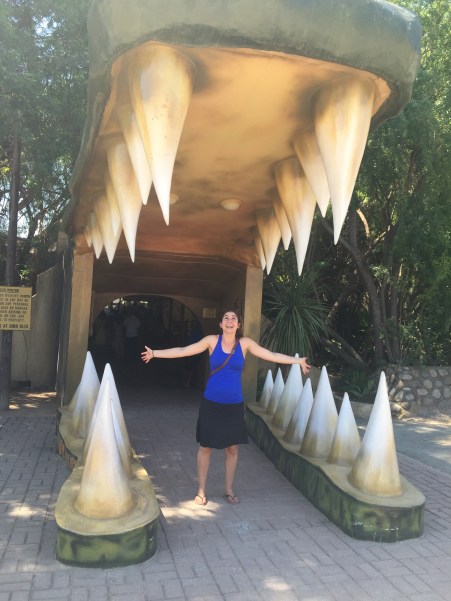
The next day got even more hands-on with the Cango Wildlife Ranch tour. Here’s the entrance:

IMG_8765

As close as I got to a crocodile, since David and I chose to pass on being lowered into the croc pool in a cage… although we did see two boys do that and live to tell the tale

Our favorite part of the Cango Wildlife Ranch was hands down the fact that they had something called an “Animal experience” where you pay a little extra to get to go in the cages with certain animals (I’ve never heard of this type of thing in the US, probably because zoos are afraid they’ll get sued if anything goes awry). David and I picked to visit with lemurs and cheetahs:

David has always been a cat person and he did such a good job petting one of the baby cheetahs that it actually started purring.

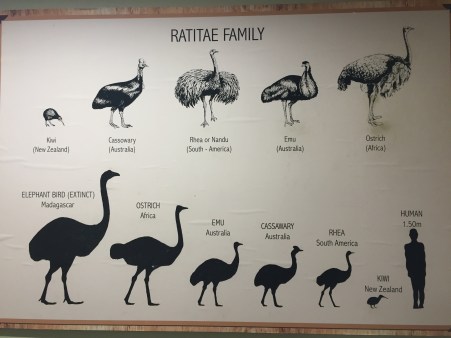
Our last adventure in Oudsthoorn was to tour one of its many commercial ostrich breeding  farms. Ostriches are farmed extensively around South Africa and particularly in the Oudsthoorn area for their meat, leather, and feathers.

Personally I was interested because I think ostriches are hilarious looking, and I heard the farms sometimes let you ride the ostriches if you arrive early enough in the day…

IMG_8777

Flightless birds by size

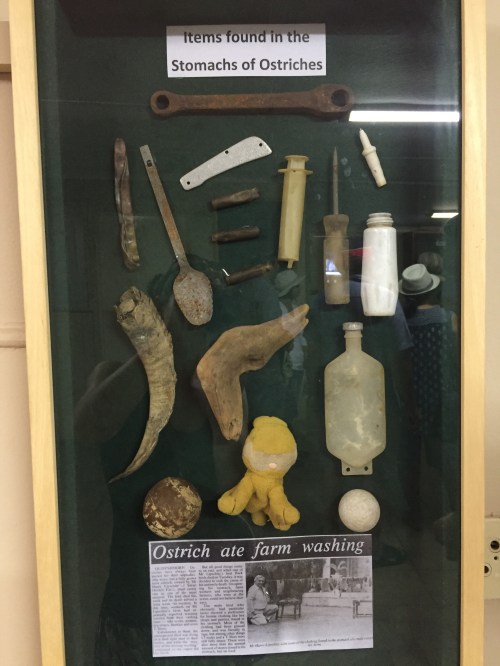
We learned that ostriches aren’t necessarily the brightest bulbs in the box when it comes to feeding themselves and will pretty much eat anything they come across:

IMG_8778

Case in point. Yikes!

They gave us a metal spoon to feed the ostriches with, but “Danger Dave” decided to do it with his hand. Ostrich eggs are are super strong as you can see from the fact that I’m standing on two of them (don’t worry, no babies inside):

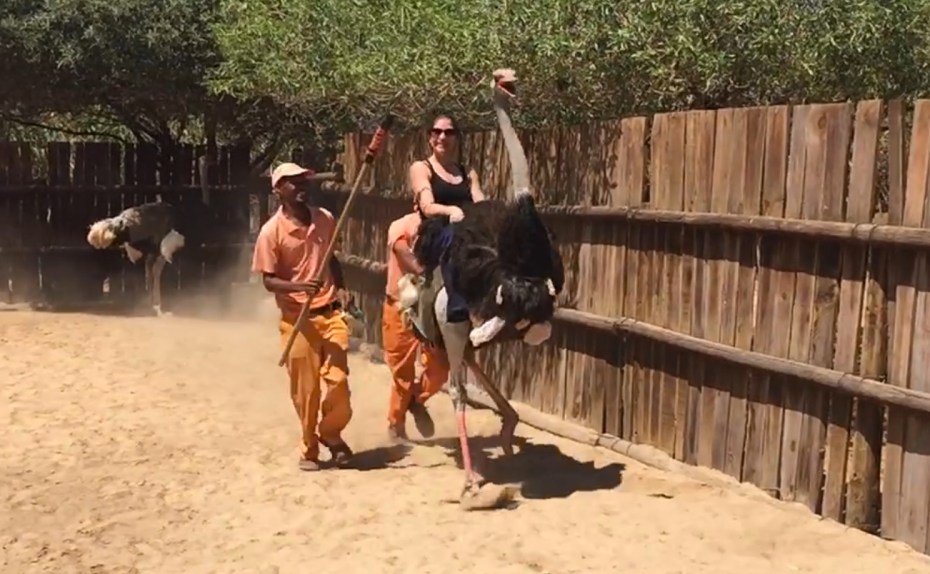
The creme de la creme was when I was chosen to ride an ostrich. I was wondering if riding a bird constituted as animal cruelty, but I figured the ostriches that get ridden have a better life than the ones who get eaten! Also, they only let you ride before the heat of the day and if you weigh under a certain amount (I had to stand on a scale to prove it).
Oudtshoorn

IMG_8835

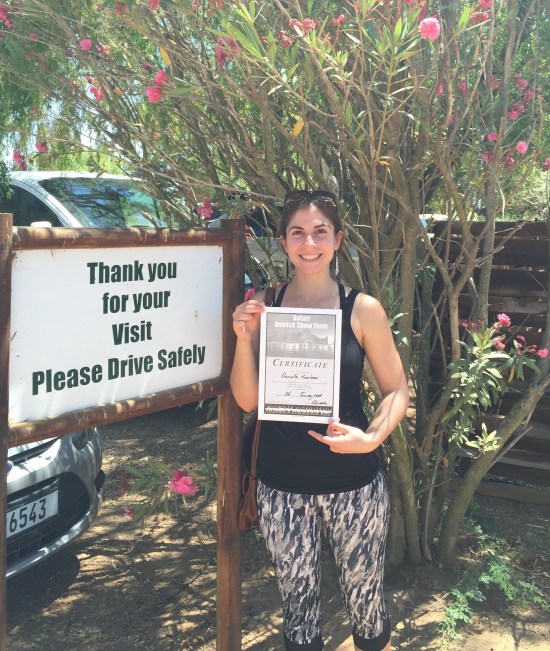
Certificate of skill and daring for riding the world’s largest bird

Holding a lemur, petting a cheetah, and now this…. an ostrich driver’s license?! Now, dear reader, you may be saying to yourself– this has to be the pinnacle of Ms. Danielle’s travel adventures. Why should I even keep reading, it can’t possibly get more exciting than this… But, on the contrary, the adventures continue! And especially if you love animals, South Africa has so much more in store for you.


Categories: Uncategorized | Leave a comment

More Madrid

This post will be a short one because it only covers 5 days. But an important 5 days since they’re my last 5 in the continent of Europe! I took this first photo to set the mood:

IMG_2567

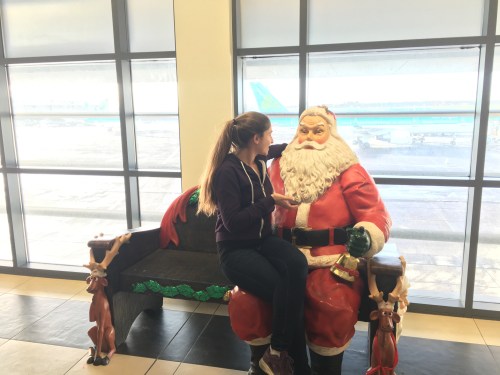
Here I am in the airport in Dublin (I know Ireland happened a couple of posts ago, but I thought the photo fit better here!) discussing all the things I want for Christmas with the man in the red suit.

Both David and I are Jewish but we each have a parent that celebrated Christmas or “La Navidad” (in Spanish) with us growing up, so Santa and I go way back. Wondering what’s on my Christmas list? I’m telling him I want to see 10 more countries in the next 6 months, meet up with 15 old friends, and make 20 new ones! He said those are things he can’t put under the tree for me, but I said, “Papa Noel, (his name in Spanish) that’s even better, since I do NOT have room for anything else in my backpack.”

This time around in Spain we stayed in a neighborhood called, “Lavapies”—which literally translated means “foot washer.” Many street and neighborhood names in Spain have Christian origins and Lavapies refers to Jesus washing the feet of his disciples.

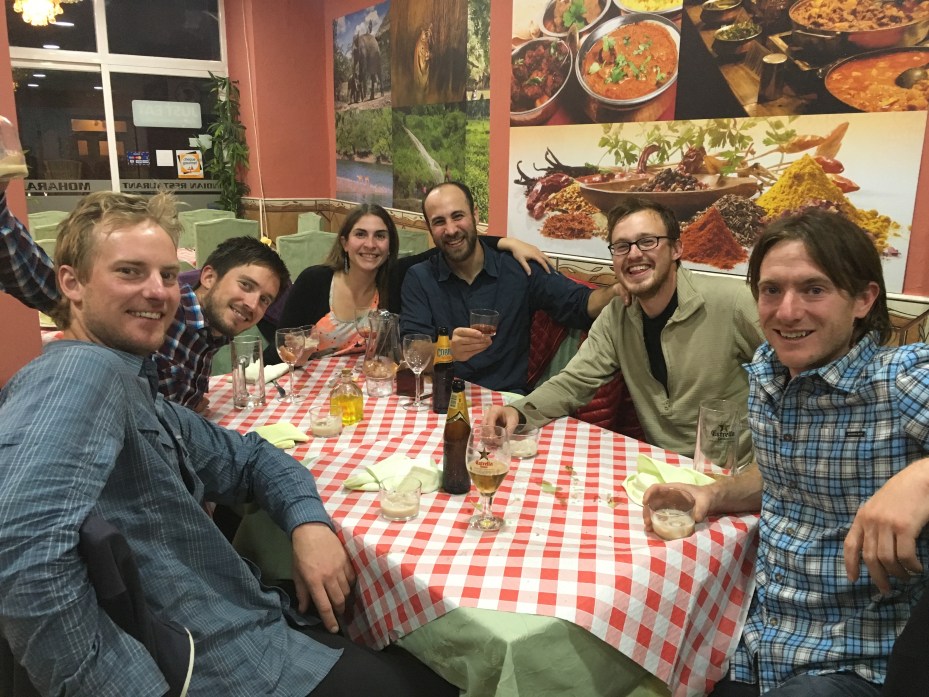
Lavapies and its surrounding neighborhoods felt deserted on Christmas Eve. Several of David’s friends from his rock climbing course with the Mountain Training School in Northern Spain were in Madrid for the night and so we met up with them for Christmas Eve dinner. All restaurants and stores were closed except if they had non-Christian owners so we had the option of Chinese or Indian food. Can you tell from the photo which one we went for?


IMG_2828

Maharaja Xmas Eve din din with the rock climbers: (from left to right) Josh, Nate, Ray and Mitch

IMG_8135

Nate and David in the Puerta del Sol

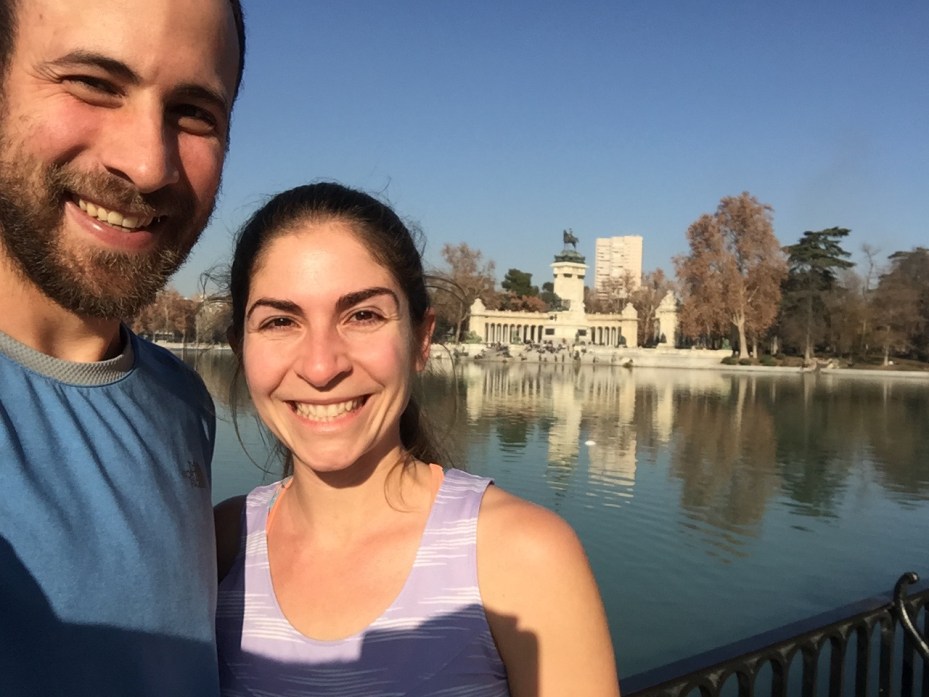
On Christmas day there were plenty of people out and about in Madrid. We saw tons of families enjoying their Friday off, especially during our run through Parque Retiro.

IMG_8140

A quick stop for a photo op in front of the Monument to Alfonso XII during our run through Retiro.

We had Christmas Dinner at a beautiful restaurant in Lavapies with my friend Sophie (remember her from Barcelona?)

On December 27th we took the metro to the Barajas airport in Madrid.

IMG_2872

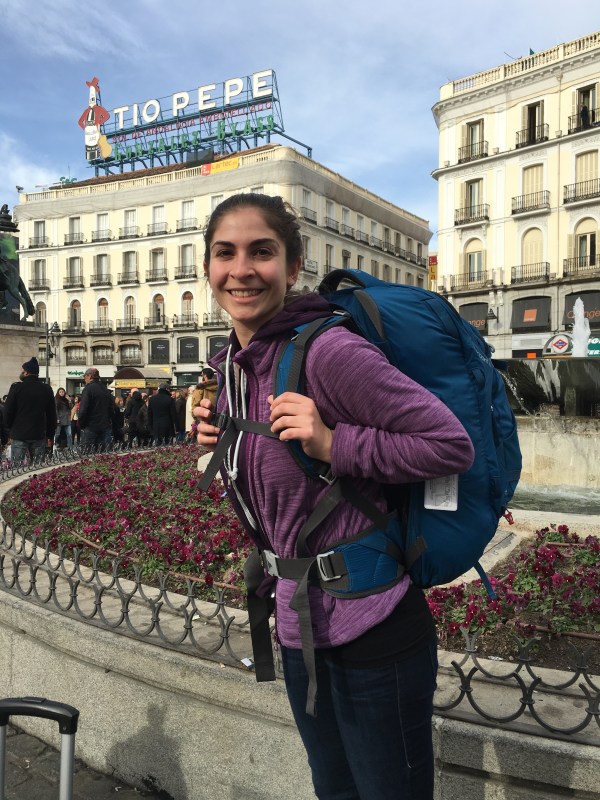
Plaza del Sol and the much-loved “Tio Pepe” neon sign (it’s a Madrid landmark)

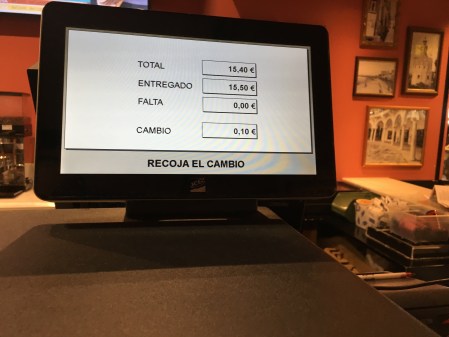
In the airport we ordered several small sandwiches and tapas from the chain restaurant “100 montaditos.” We had a serious pile of change which we hadn’t counted, but when we handed it over to the cashier it turned out we’d ordered perfectly– we spent it with .10 euro-cents to spare!

IMG_2874

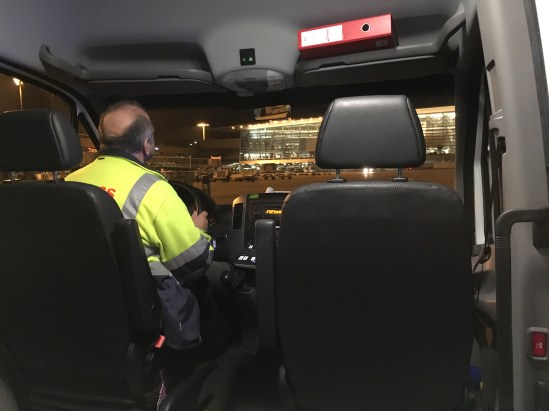
Our flight from Madrid to South Africa was supposed to have a 2.5 hour layover in Zurich, Switzerland, but our flight was delayed two hours in Madrid. This meant when we landed in Zurich we had very little time to go through customs and then make it to our flight so there was a personal shuttle waiting for us as soon as we got off the plane. The man in the yellow jacket drove us to our own little passport control booth and then straight to our next gate, just in the nick of time!

IMG_2877

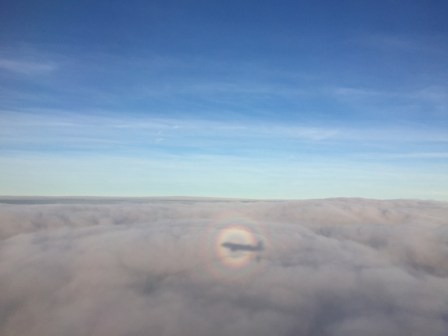
Below is our plane before and after it’s 13 hour journey from Switzerland to South Africa. That’s enough time to eat dinner, watch two movies, get 4 or 5 hours of sleep, eat breakfast, and watch one last movie before landing !


Categories: Uncategorized | Leave a comment

School in Scotland

Remember the blog post I wrote back in November about the Montessori school at Arterra Bizimodu in Spain? I heard about that project from a friend of mine, Ethan, whose job sends him all over Europe and Asia (and sometimes South America and Africa too) helping communities called “Ecovillages” to grow and develop (I’ll explain more about ecovillages below). Ethan spends about a third of the year at one of the more famous of these communities, called the Findhorn Ecovillage in the North of Scotland. Findhorn is home to over 450 residents as well as dozens of community businesses and several non-profit organizations. It hosts workshops, speakers, and visitors from around the world.

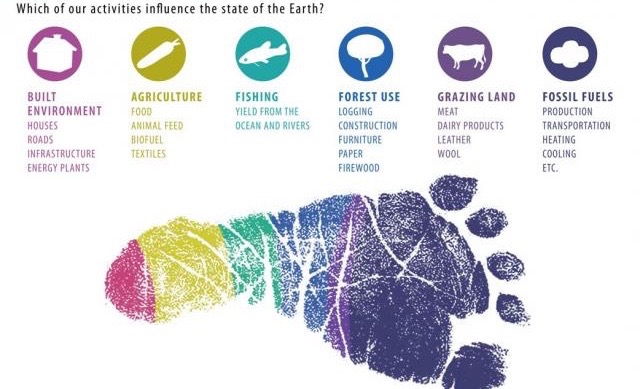
The organization Ethan works for is called the “Global Ecovillage Network” (GEN). “Ecovillage” is a newish term used to describe a community that makes a special effort to live in harmony with nature and minimize its “ecological footprint.” What’s an ecological footprint you ask? In a nutshell, it’s the share of Earth’s resources we use to support our lifestyle. If you’re curious what your own Ecological Footprint might look like, play this quick game!

ecological-footprint (1)

Some of the components of an “ecological footprint.” (Image borrowed from this post)

The residents of ecovillages around the world work together to reduce their impact on the Earth in many creative ways ranging from the way they design their homes and produce energy to how they grow food and share tasks, like cooking. At Findhorn, many of the residents eat together. The communal kitchen serves breakfast, lunch and dinner and feeds more than 250 people a day!

cluny college (1)

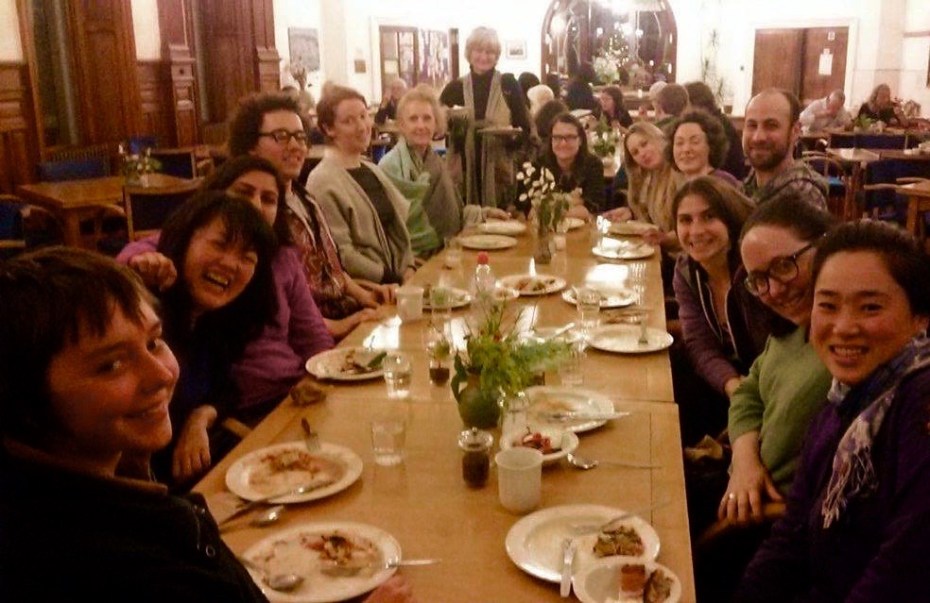
David and I with our “Experience Week” group. Because so many visitors are interested in learning from Findhorn’s example, you need to apply and be accepted into a special week-long program for visitors.

From Dublin, David and I flew into a town called Inverness, took a public bus to Forres, and then another bus to the Findhorn Foundation. Ethan met us at the bus stop and we got to hang out with him and his friends for a night before we headed to “Cluny” the next day– Findhorn Foundation’s other “campus” another short bus ride away.

Some people call Cluny, “Cluny College” because it plays host to the weekly visitors from around the world who come to take part in Experience Week, a introduction to the Findhorn Foundation that’s required if you want to participate in other workshops or programs there or ever live or work at Findhorn. Ethan, Benyamin, and Pavi (above) had all participated in it. Ethan had recommended it to me and David, so we’d applied for scholarships to attend and been granted them!

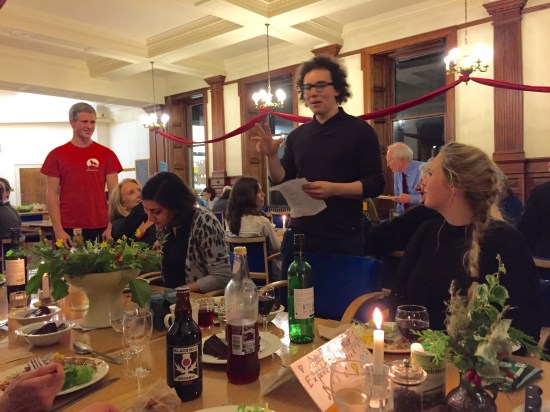
So we go to Cluny College for the week! Our group of 16 is from France, Sweden, Scotland, England, Japan, Canada, Denmark, and the US. We’re all assigned our own hotel-like room, and we have a non-stop schedule from 8 in the morning until 8pm at night or even later. We “attune” to our volunteer tasks for the week, which means instead of requesting our jobs, we walk around a room full of blank pieces of paper until one calls to us and then we go stand on it. Once everyone’s picked a paper to stand on, we turn them over and read our jobs. This system means I could have been making beds and cleaning bathrooms all week, but luckily my “attuning” powers knew I liked to be outside, and I’d picked a piece of paper that put me in the Cluny Gardens:

David worked in the Cullerne Gardens and specifically excelled at making a delicious compost mixture of food scraps, manure, straw, and egg cartons:

Other entertainment throughout the week included lectures from people who live in Cluny, group dances, singing and games. There was also a lot of sitting in circles and talking. Hey, did you know in the United Kingdom there’s no such thing as the “hokey pokey”? Nope, it’s called the “Hokey Cokey” and the song’s a bit different too, including this little portion: “Knees bent, Arms stretched, Rah Rah Rah”(click on this Hokey Cokey link to hear the full song) One afternoon we go to the Findhorn River and take a beautiful hike to a snowy beach:

On the last night we enjoyed delicious vegetarian Haggis (the vegetarian part is key because this traditional Scottish dish would otherwise include sheep’s heart, liver and lungs!) with “Neeps and Taties” (mashed turnips and potatoes).

IMG_7941

At the end of the week, we said goodbye to our new friends and went back to stay with Ethan for a few more days.


IMG_7993

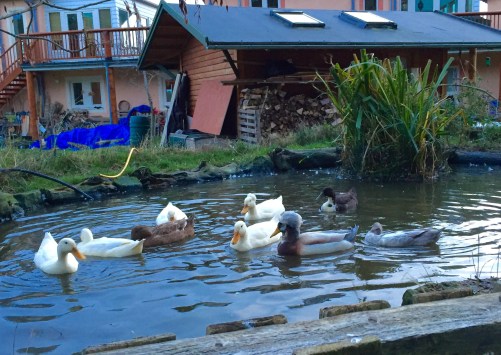
Ethan’s backyard neighbors. Check out that hair!

IMG_2717

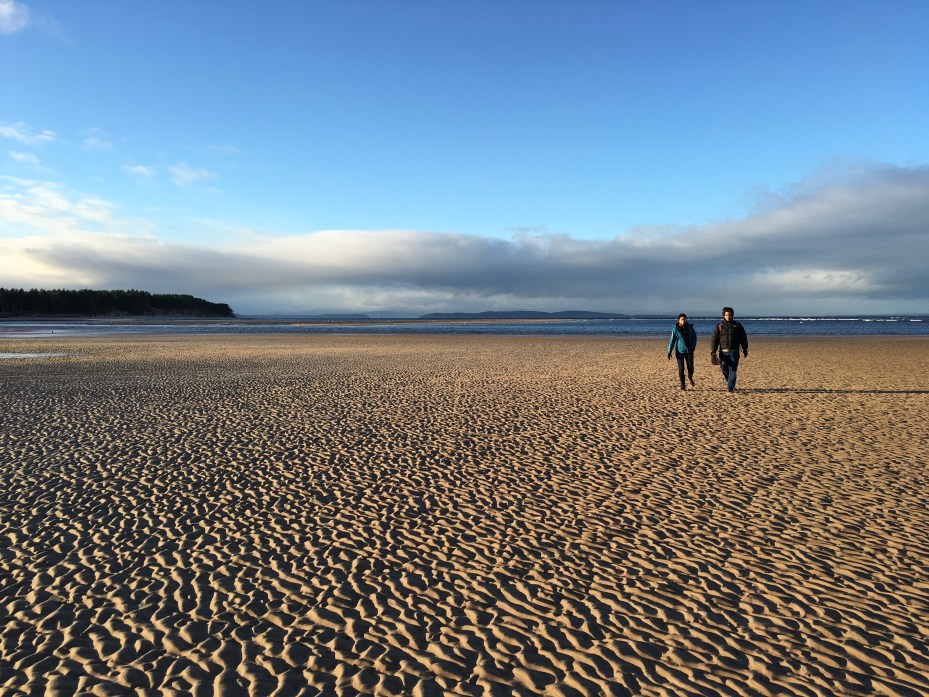
The beach in the town of Findhorn, Scotland about a 15 minute bike ride away.

IMG_2723

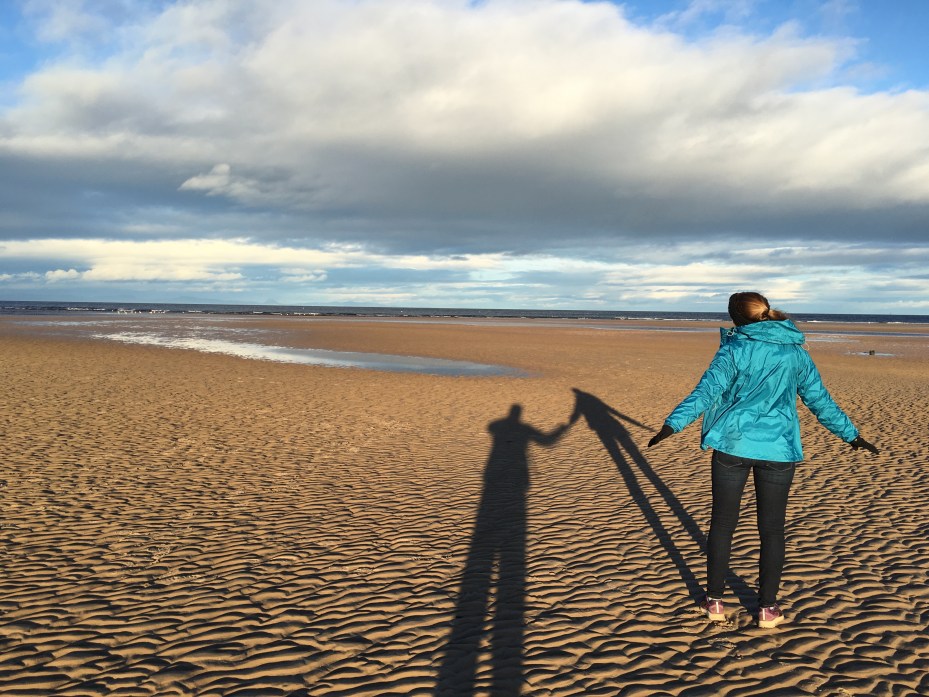
Shadow handshake

Before leaving Scotland, we took a road trip down to the capital, Edinburgh, with another new friend, Katie, who Ethan had introduced us to the night before.

In Edinburgh, we stayed across the street from a lively Holiday market.

IMG_2748

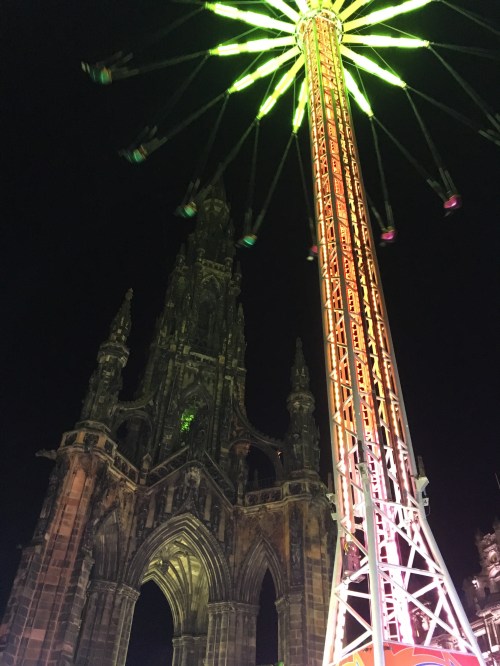
We made the most of our one full day in Edinburgh by taking another Free Walking Tour like we’d done in Amsterdam. This time our tour guide’s name was Johnny and we learned all kinds of random facts from him including:  1) Edinburgh has a building that’s the tallest monument in the world to a writer (Sir Walter Scott- he wrote Ivanhoe among other books).  2) The unicorn is the national “animal” of Scotland.  3) A couple hundred years ago Scotland decided to brand itself as the “Athens of the West” and invited an architect to make their city more Greek and Roman. Cue statues such as Alexander the Great (who never came to Scotland, let alone knew the United Kingdom existed) and the statue of Scottish philosopher David Hume wearing a toga and sandals (an outfit he never wore) to make him look more “Greek.”  4) A fun fact about the heart below, which is found in front of St. Giles’ Cathedral: Several foreigners have found it romantic to propose in the heart; HOWEVER this marks the location where the tax office used to be and everyone else spits in the heart for good luck, so maybe not the best choice for a spot to get down on one knee.

Johnny also explained to us that Edinburgh’s “Cathedral” is actually a church since in recent Scottish history (ie after the 1600’s), the Church of Scotland hasn’t had bishops or dioceses and thus there haven’t been “cathedrals” in the formal sense. Also the church’s very old-looking stained glass windows were actually installed in the 1990’s. There is, however, a wooden carving of an angel playing the bagpipes, which Johnny challenged us to find and David and I succeeded in doing with the help of a friendly volunteer who let us into the locked Thistle Chapel.

Another interesting fact we learned from Johnny is that 300-years old, Scottish burglar alarms consisted of a “trip step” on your staircase, which was a stair that was slightly taller or shorter than the others so that the burglar would fall making a loud noise that would wake the sleeping owners and thus prevent a burglary.

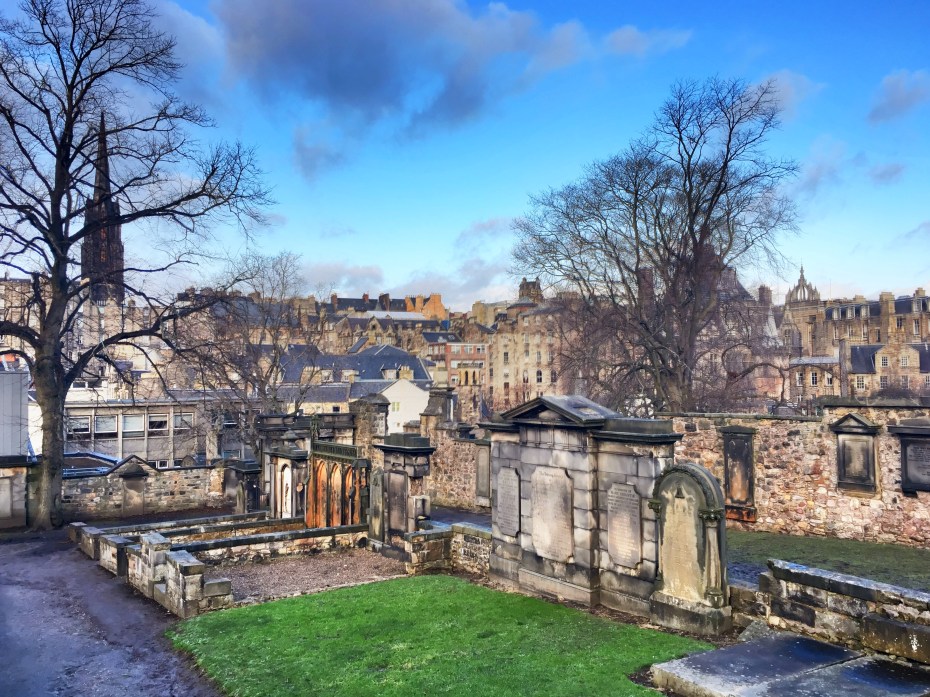
The last stop on the tour was Greyfriars Kirkyard, a graveyard with not one but two claims to fame. The first involves one of Edinburgh’s most well-known characters: none other than a dog named Bobby. Bobby was the loyal companion to a night watchman named John Gray in the 1860’s. When John Gray died he was buried in Greyfriars Kirkyard, and Bobby is said to have loyally slept by his master’s grave for the next 14 years. When Bobby died in 1872 he was buried in the graveyard as well and a statue was commissioned in his honor.

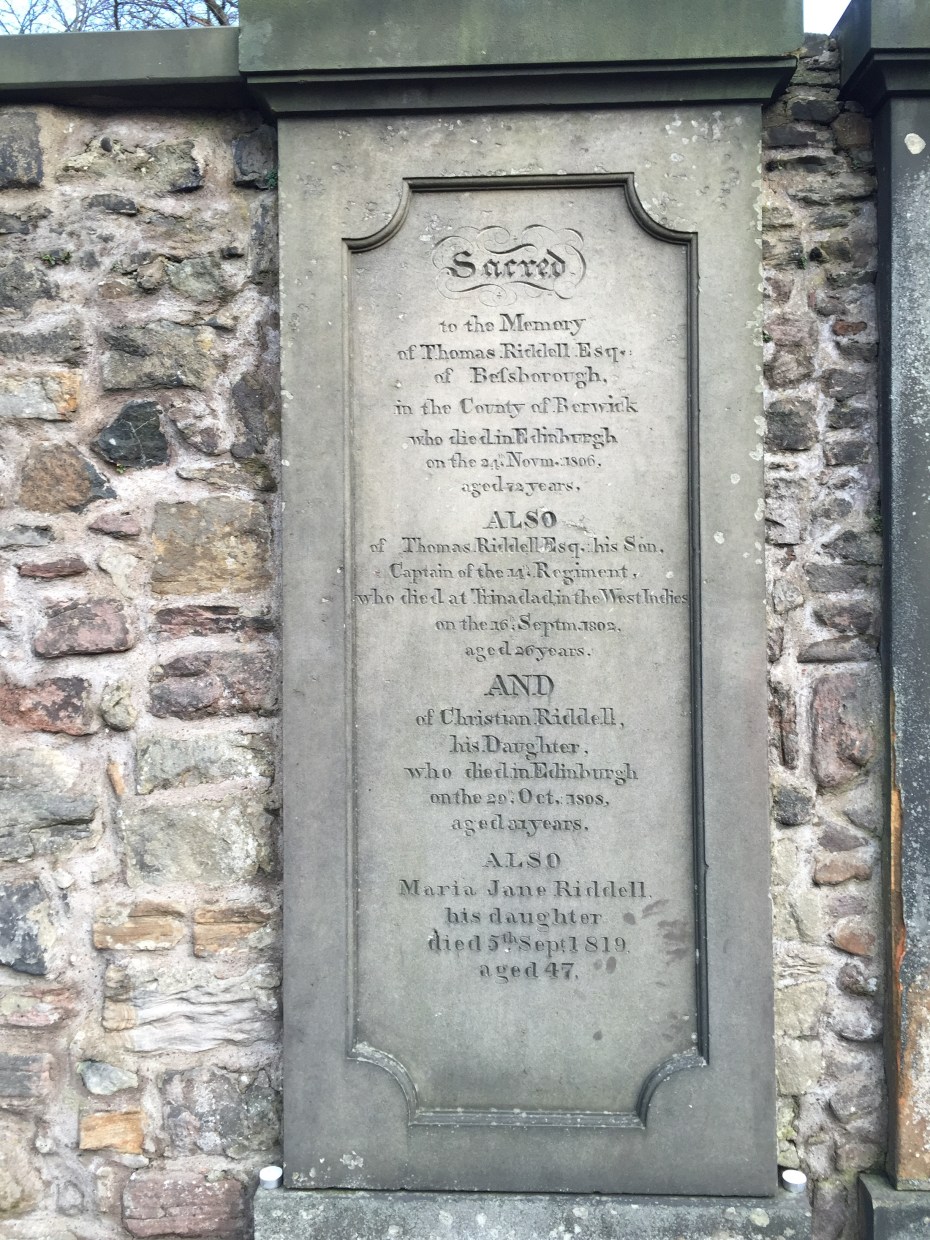
Greyfriars Kirkyard has enjoyed recent fame because of the fact that JK Rowling used stroll through the graveyard and a few of the names she read on tombstones may have inspired some of the characters’ names in Harry Potter. For example the tomb of poet William McGonagall = “Professor McGonagall.” And the tomb of the unsuspecting “Thomas Riddell Esquire” now receives all sorts of fan (and hate) mail for being the true name of Rowling’s villain, Voldemort.

IMG_8083

Gravestone of Thomas Riddell


IMG_2765

Greyfriars Kirkyard

One more tidbit for Harry Potter fans: behind the graveyard is the Elephant House Cafe, where JK Rowling wrote the 3rd and 4th Harry Potter books (do you know what the titles are?) The bathrooms at the Cafe, which are covered in fan writings about the books and their characters, have become a tourist attraction in and of themselves (I guess this is one instance in which graffiti is welcomed- as long as it’s on topic!):

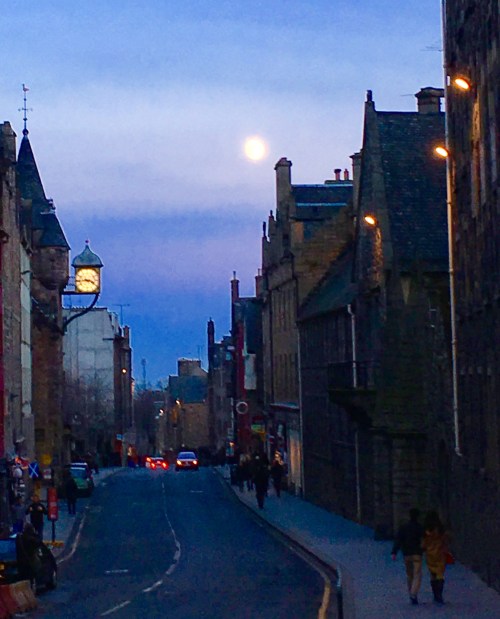
After the tour, we saw a few more scenic scenes of Edinburgh on our own that afternoon and evening:


IMG_2786 (1)

This time tomorrow we’ll be heading back to where we started this whole journey: España!

Categories: Uncategorized | Leave a comment

Bright Green Ireland

We landed in Cork not having planned anything, not even where we’d be staying that night. But Cork is in the south of Ireland, so it made sense to us to rent a car at the airport and work our way North to Dublin, where I discovered I had cousins (although they’re not Irish-they moved to Dublin from Boston two years ago- more on them later)!

IMG_2377

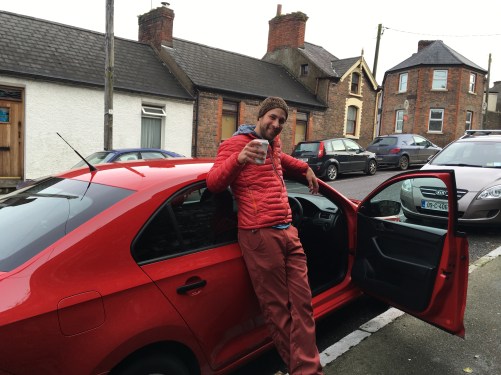
David matches our car, which we name… “Red.” We just keep outdoing ourselves with these inventive names, huh? Note the steering wheel is on the right side of the car instead of the left!

Renting a car is actually not easy. First, their policy is to charge such a large security deposit (money they give back to you when you return the car in perfect condition, but keep if you damage it) that I have to call my credit card company to have them raise my spending limit. In addition, 2 out of my 3 credit cards won’t even provide insurance for cars rented in Ireland. Why? As best we could gather, there are a lot of accidents due to bad, narrow roads and possibly tourists who have never driven on the left side of the road before. In my mom’s words, “Don’t drive. Roads and drivers and sheep are crazy!”

IMG_7771

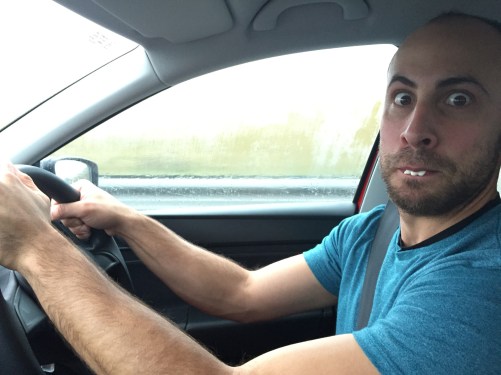
David did an all-star job of navigating the Irish roads. And even if he sometimes got in the passenger side of the car by mistake (we had an ongoing competition to see who went to the wrong side of the car more often)- he was always on the right side of the road- and by that I mean the left side.

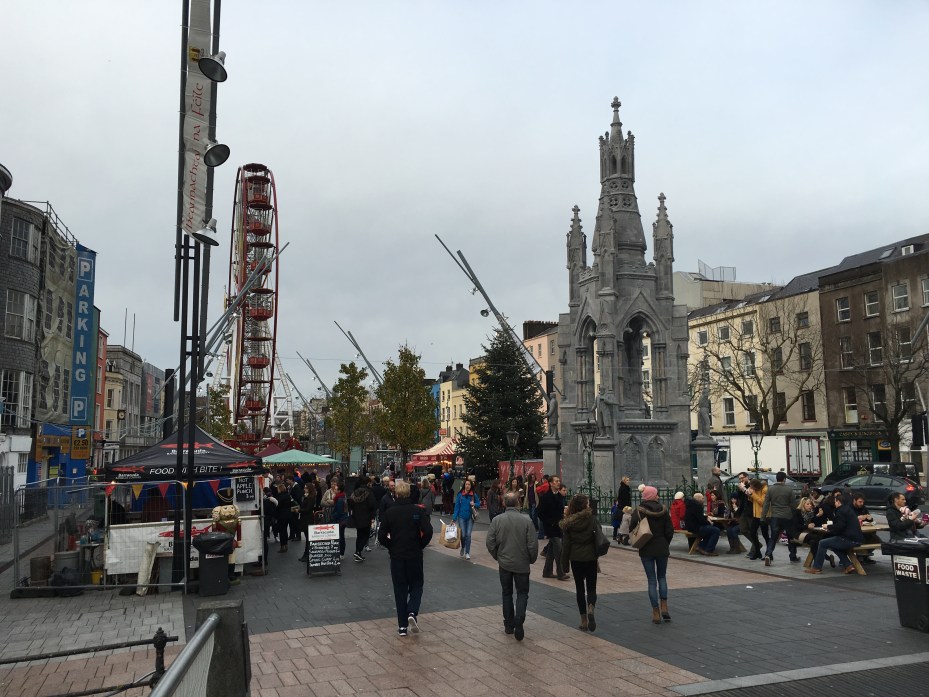
My mom informed me that my grandfather’s mother’s side of the family was from Cork. Although we don’t know of any relatives there now, it still made it that much more special walking around town and imagining my ancestors doing the same.

IMG_2380

Wait a second- something about this picture looks familiar… I guess other cities besides Amsterdam are allowed to have rivers and bridges! This is the River Lee in Cork.

IMG_2382

While walking around Cork, we were very happy to stumble upon the Quay Co-op. They have a vegetarian restaurant upstairs and a grocery store downstairs that reminded us of a smaller version of our favorite market in San Francisco: Rainbow Grocery!

IMG_2381

We lucked out that there was a lovely flea market going on across the river from the co-op. I bought some earrings made from old vinyl records. Maybe you’ll spot them in a later photo. 

At the airport and rental car spot we kept seeing signs for the “Wild Atlantic Way,” which is a (very!) scenic driving route over 1,550 miles mainly along the West Coast of Ireland. We initially headed South from Cork, following the squiggly symbol for this route and stopping in interesting-looking towns along the way.

WAW_NationalMap_4

Look for the start of the Wild Atlantic Way in Kinsale. It goes up to Derry in North Ireland, which is technically a different country (it’s part of the United Kingdom like England, Scotland, and Wales)!

IMG_2390

Our first Irish Pub in Ireland was in a cute little town called Kinsale.

IMG_2394

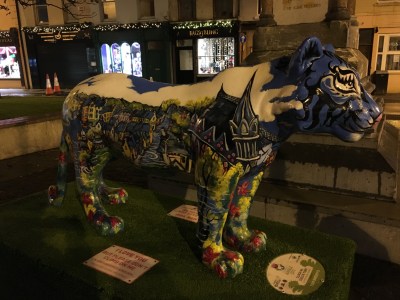
Tiger art in Clonakilty

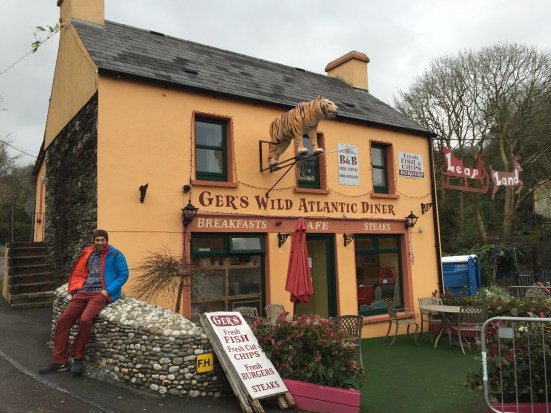
We found a quirky AirBnb to spend the night in a town called, “Leap” (pronounced Lep). The owner, Ger, creates an elaborate Christmas Village in his backyard every year.

IMG_7612

We are excited to visit a town with an American name- Baltimore- (hmm, although the one in Ireland was probably named first) because we hear it’s got quite a “beacon.”

IMG_2421

At breakfast they warned us not to go near any cliff’s edge. At the Baltimore Beacon I realized they weren’t kidding… It was REALLY windy.

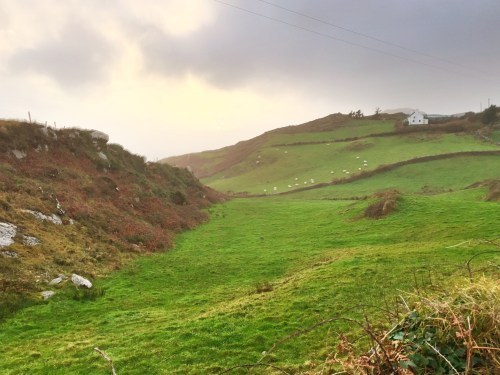
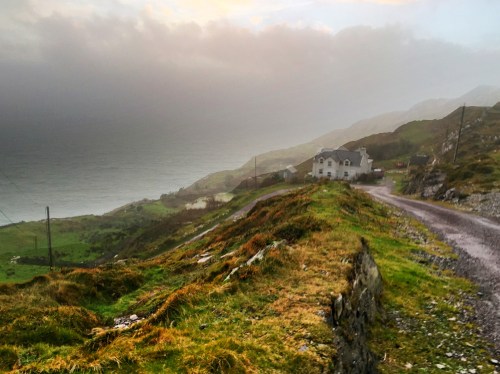
Other stops that day included Durrus, Kilcrohane and “Sheep’s head” where it was so windy we couldn’t actually walk to the head, but here are some of the views we captured from the road:

IMG_2456

Can you spot the sheep?

IMG_2457

We did get out of the car at Altar Wedge Tomb in Toormore:

In Dingle we visited a very Irish-seeming pub called O’Flaherty’s where a group of about 8 men were making Christmas costumes out of straw for Wren’s Day (the day after Christmas).

As we continued along the Wild Atlantic Way, we were lucky to get breaks in the rainclouds for some beautiful scenery. The Gallarus Oratory below is estimated to have been built between the 6th and 9th centuries which means it could be more than 1,500 years old! The stones are cut on every side and end to fit perfectly together so that no mortar was needed on the outside.

From the Dingle Peninsula, we took our trusty rental car “Red” on a ferry from Tarbert to Killimer. This saved us a bunch of time on our drive to Galway.

Galway, one of Ireland’s larger cities, will be our last stop on the Wild Atlantic Way before heading East to Dublin.

IMG_2529

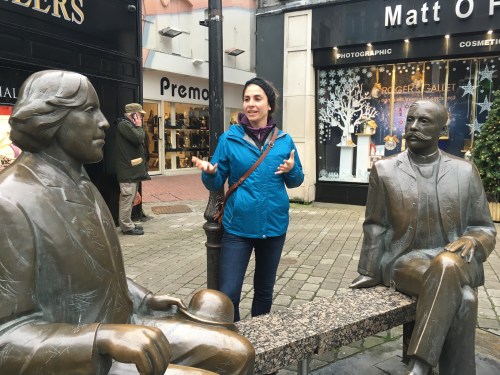
Having a little chat with 19th century Irish playwright, novelist, essayist, and poet, Oscar Wilde. He’s telling me, “My own business always bores me to death; I prefer other people’s.”

IMG_2526

Galway is a University town and you can listen to amazing live Irish music any night of the week.

We made it to Dublin in time for Hanukkah! Two years ago my cousin-in-law Barbara– who’s married to my cousin Ronnie of the wandering “Hardoon” tribe (though he spells his last name slightly differently than my family does)– got a job as a professor in the School of Irish, Celtic Studies and Folklore at University College Dublin. Barbara and Ronnie’s daughters, who grew up speaking German, Hebrew, and English can now add “Irish” to their repertoire (which is English with a charming accent and word choice). I had last seen them about 7 years before when they were half their current heights, so I particularly enjoyed catching up with them and hearing about their Irish lives and schools.

The next day while Barbara went to work and Hannah and Mira went to school, David and I took the Dart Train (similar to the BART) from Blackrock into Dublin to do some exploring. Ah it feels good to be on vacation. PS Barbara had set out a lovely breakfast for us that morning, so we had the true European B&B experience 🙂

We decided against taking a boat from Northern Ireland to Scotland, which meant we could have a full day in Dublin and one more night with cousins (and a comfy bed).

IMG_7774

Me and my “Irish” cousins eating Latkes in Dublin- From the left, Barbara, Hannah, and Mira.

Luckily there were cheap, last-minute flights (see the demand for seats below) so this change of plans worked out great. On to our last European destination!

Bye Ireland. Hope to see you again soon!


Categories: Uncategorized | Leave a comment

Adventures in Amsterdam

IMG_7577

At the beginning of December I bit the bullet and finally left my beloved Spain for a place with a much trickier language (at least for me): Amsterdam. Amsterdam is the capital of The Netherlands, a country which some people erroneously call “Holland”; however, Holland is not the name of a country, it is a province in The Netherlands (in which Amsterdam is located).

IMG_2170

The Amsterdam airport. The rain cover is on my backpack in preparation for the first rain I’d seen all trip!

Luckily most signs are in both English and Dutch, but the names were still very hard for me to know how to pronounce (for example, metro stations such as Snevlietweg, Ouderkerkerlaan, Wilbautstraat….)

IMG_2173

There’s an easy-to-navigate train from the airport to the city center. Behind David is the train station, “Amsterdam Centraal.”

David and I spent 5 days in Amsterdam. Here I’ll tell you about some of my favorite things:

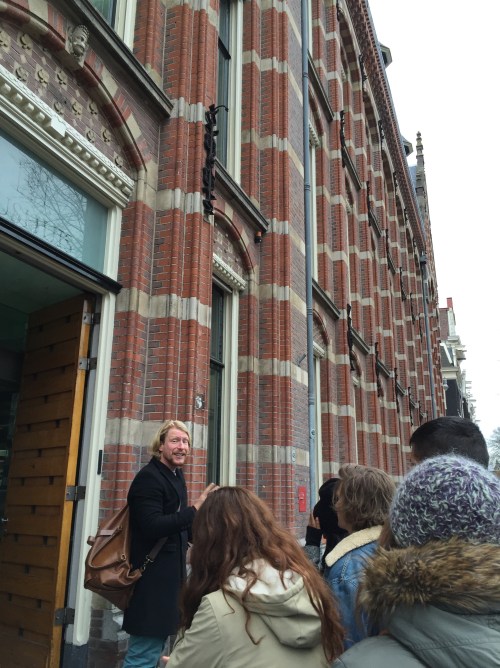
We took a 3-hour walking tour that marched us all over the city. Our guide, Kor, had has laughing until our sides hurt since he peppered all his facts with wisecracks. This is a nice way to learn A LOT of information.

IMG_7475

Here Kor is standing in front of the Dutch East India company explaining that the business, founded in 1602, put some of its fortune, accumulated in the spice trade, toward helping America win the Revolutionary War.

IMG_2201

If you pay attention, you’ll see many of the buildings in Amsterdam appear to be crooked or leaning forward slightly (Can you spot this?) This is because Amsterdam was built on swampy land, which has caused some buildings’ foundations to sink and tilt. Do you see the hooks on the front of the homes? You have another chance to spot them below. 

IMG_7495

The hooks are used with a rope and pulley system to lift furniture through the windows into your home. They’re necessary because most of the old homes in the city of Amsterdam have narrow, steep staircases (and no elevators!)

One of the most famous houses in Amsterdam (it gets over 1 million visitors a year) is the Anne Frank house, where 13-year-old Anne spent two years in hiding during World War II. If you’re a teenager (or older!), you should read the very sincere diary she wrote during this time, “The Diary of a Young Girl.” It has become so famous that it’s been translated into over 60 languages.

anne-frank-house

The house where Anne Frank and her family were in hiding (it’s now a museum) is to the right of the house with the red shutters. I came here as a 13-year-old girl with my dad, but this time around, I learned something new: Before she went into hiding, Anne was attending a Montessori School!

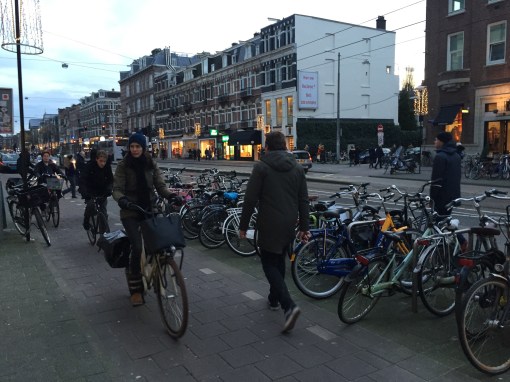
A similarity between Amsterdam and San Francisco is that people love to ride bicycles. There are more than one million bikes in Amsterdam- in fact, there’s even more bicycles than there are people living in the city of Amsterdam! It is the most bicycle friendly capital in the world and also the most bicycle friendly city with over 1 million people. Needless to say, if you’re a pedestrian please look all ways before crossing the street/bike path/sidewalk!

IMG_7544

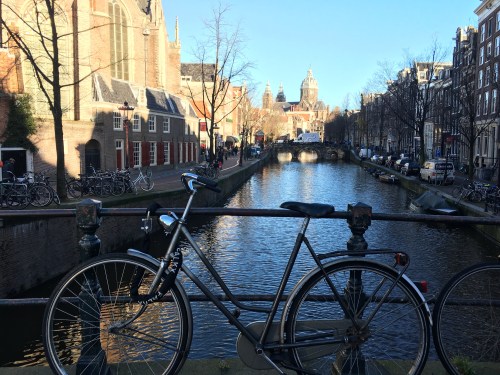
Amsterdam also has a lot of canals- 165 to be exact!- and has thus earned itself the nickname, “Venice of the North” (Do you know what country Venice is in?) So many canals means lots of bridges. I heard different numbers, but it seems there are at least 1,500 bridges in Amsterdam.

IMG_2270

They were having a special holiday light show on some of the canals while we were there and here you can see some of the works of art (light) that we photographed during our Canal Cruise:

A funny coincidence during our cruise: we just so happened to get on one with a bunch of tour guides including Kor who had been our guide 2 days before! (it was an event the Free Walking Tour company organized for guides). Kor was born and raised in Amsterdam, but we also learned that the tour guides came from all over Europe and even the US- people who loved Amsterdam so much when they visited, they found a job that allowed them to stay for years!

During our short trip we also enjoyed visiting:

IMG_2288

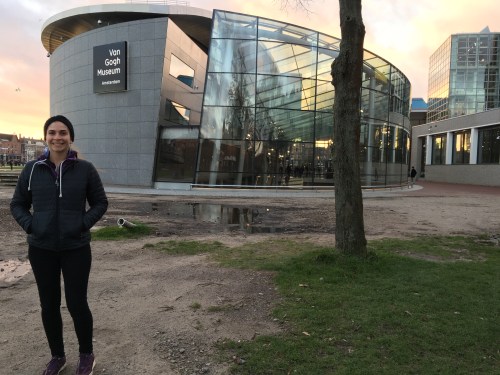
The Van Gogh Museum

IMG_2295

The Rijksmuseum

IMG_7528

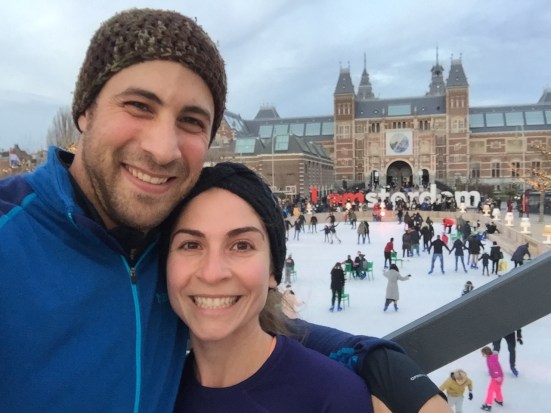
Here’s the Rijksmuseum up close with the seasonal winter skating rink and iconic “I amsterdam”statue.

In the photo above we’re in the middle of a long run that we took from our hotel through Vondelpark. A couple more scenes from the run, including a super fun-looking slide. I wish I had some students with me to try it out and report back!

We loved the food in Amsterdam (Spain didn’t have quite as much variety- Thai food we especially missed you)… and also the junk food!

I kept telling David I had a big surprise for him for dinner because:

IMG_2267

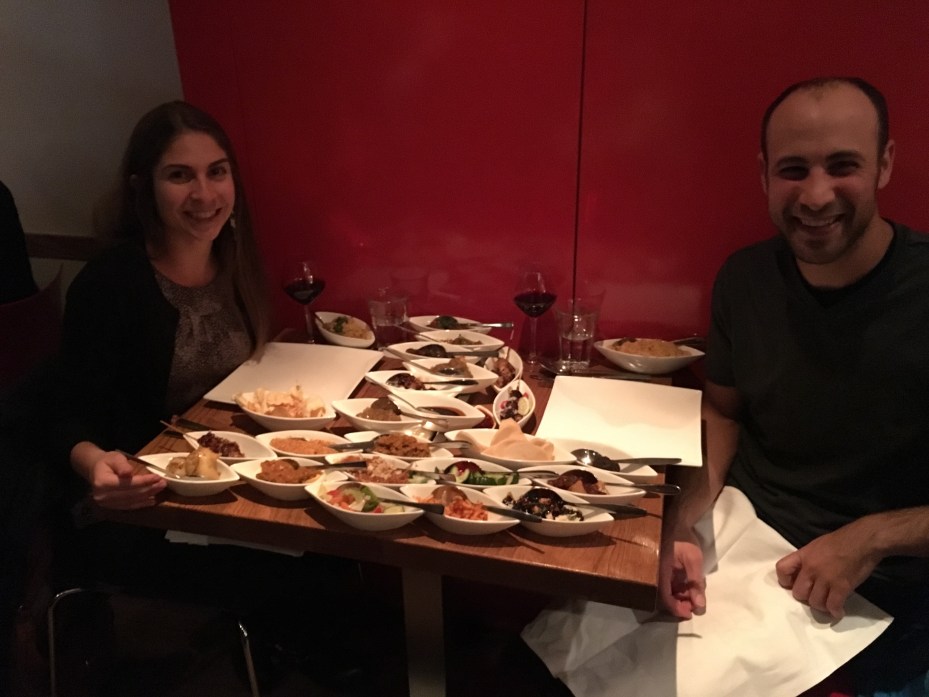
Besides being the greatest, another reason I had this insider info about the best food in town was because 18 years ago when I was in Amsterdam with my dad, brother, and best friend Margia, I had the most delicious meal of my life. I still remembered this meal and what the type of food was called: It’s a combination of Indonesian and Dutch food called, “Rijstafel.” I’ve never seen  Rijstafel again since that memorable dinner, and so I was sure David wouldn’t have heard of it. Although I couldn’t remember the exact restaurant I’d eaten at when I was 13, I looked up some reviews and found out there was a great Rijstafel place right near our hotel. I made my first dinner reservation of our trip. Why was this meal so memorable? Decide for yourselves:

IMG_2365

26-course Rijstafel meal of deliciousness at Blauw

IMG_2364

Fortunately, I did not get as full as when I was 13 (when I got so stuffed I could barely walk!) I’d been saving up for this meal all day… and maybe my stomach’s a little bigger now too 🙂

IMG_2273

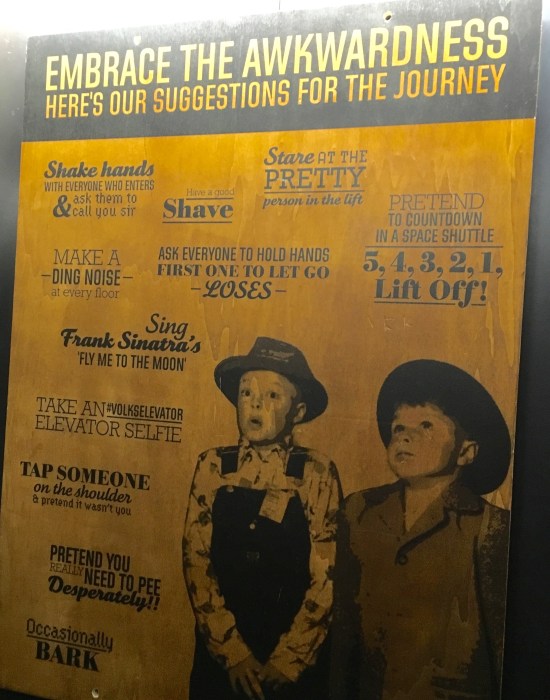
Although I’d been to Amsterdam once before, I was so happy to return almost 2 decades later. Some things had changed because I saw them with a new, adult perception, some things had changed because time had passed, and some experiences were different simply because I went to different places and learned new things. For example, all these ways to entertain yourself in an elevator, haha:

IMG_2272

Our time in Amsterdam went by too quickly, but David and I had found a $20 ticket to somewhere we’d always wanted to visit, so it was time to move on. It was a place where both of us had ancestry but neither of us (nor anyone in our immediate families) had ever been. Read on to find out where to next!

IMG_2370

Bike parking at the metro stop where we caught the train to the airport.

IMG_7575

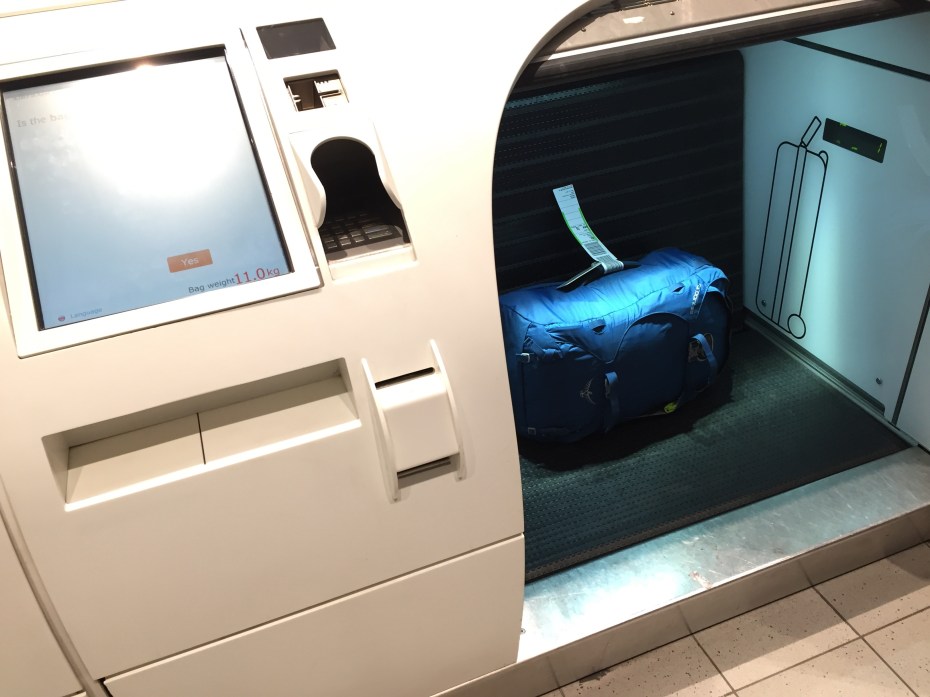
At the Amsterdam airport you check-in your bags yourself with this high-tech machine that weighs your luggage and prints a tag for it.

Categories: Uncategorized | 1 Comment

Road Trip, part II

Since we’re in “Porto,” we’ve been told we must try the Port, which is a sweet-tasting wine, often served as dessert. Unfortunately, on our way to the recommended Port winery, Google Maps takes us to literally the middle of nowhere and says, “You’ve arrived at your destination.” Data does not work on my phone in Portugal (I loaded the directions when I had internet) and there were no places around with wifi, so after some aimless driving, we found a taxi driver who had heard of the winery, Casa das Pipas, we were trying to find. Just like the woman in the Post Office, I spoke to him in Spanish, and he understood. He then gave us directions in Portuguese, but they were quite complicated, so after we stared at him blankly for a while he offered to drive to Casa das Pipas for 6 euros. This was the first time I’ve ever paid a taxi without actually getting in the cab!

IMG_7130.jpg

We weren’t planning to spend the night at Casa das Pipas, but after getting lost for a while it had gotten dark and the winery had closed, so we decided to stay in the guesthouse. Since it was the “offseason” (in other words, not a popular time for tourists to visit), we were actually the only guests in their hotel.

IMG_1832

Tiny Polar enjoys the view from the balcony at Casa das Pipas

IMG_1815

The Casa Das Pipas living room, which we had all to ourselves!

IMG_1818

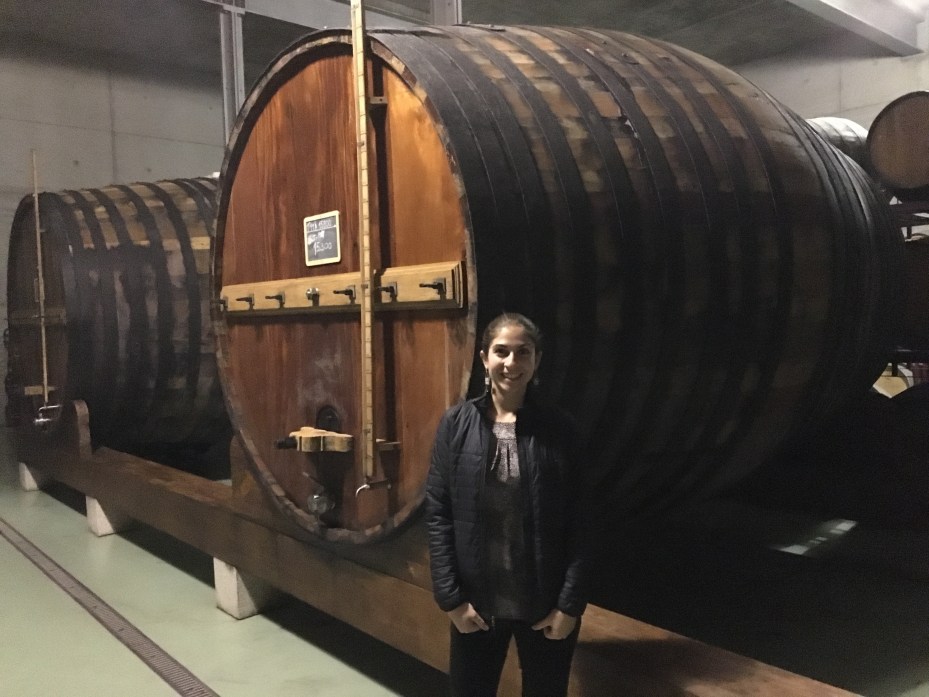
These giant wooden barrels are used to age the wine.

PS There was a family from San Francisco on our Port tour!

After leaving Casa das Pipas the next day, we got lost (again), but this time in the daylight so it was easier to find our way again. And in the meantime we took a nice photo with our rental car.

IMG_7150

We *creatively* named our car “Jet,” since the 3 letters on the license plate (almost) spell that.

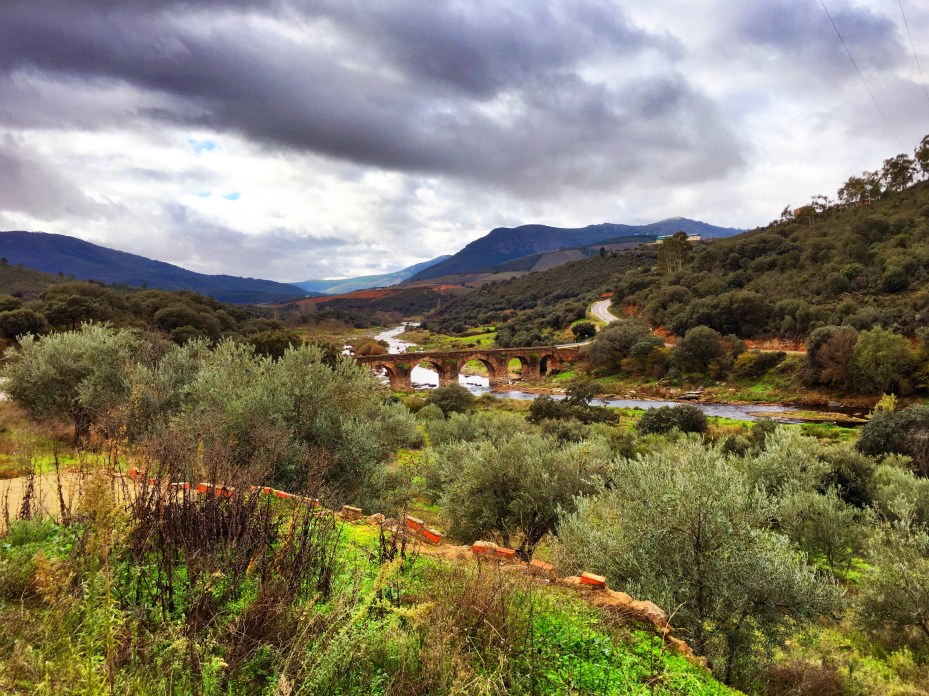
We drove through the Douro valley from Pinhao to Peso de Régua on what has been voted the most beautiful stretch of road in the world!

IMG_7160IMG_7178

Later we drove through Parque Nacional Montesinho at sunset:

IMG_7201

We finally arrived at our destination: a tiny little town in the mountains of Spain at about 10pm and guess what? It was Thanksgiving!

We’d called ahead of time to let the manager, Begonia, know what time we would arrive and to check if there was somewhere to eat “in town.” She explained the town was so small nothing would be open, but there was a “restaurant” at the hotel (in other words, a kitchen) and she was happy to cook for us if we arrived before 11pm.

IMG_1921

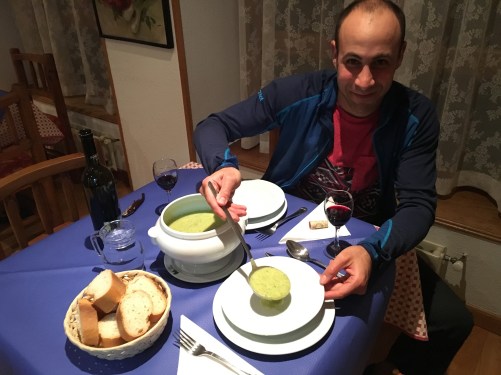
Creamy zucchini soup (enough for about 6 people)

IMG_7216

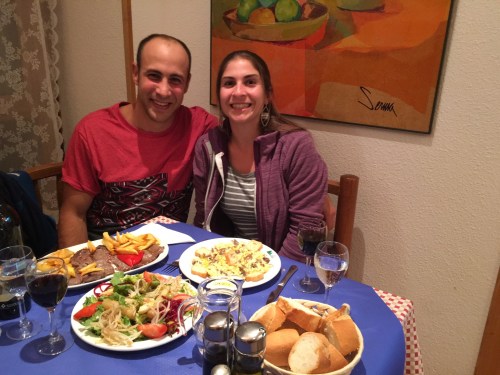
A somewhat non-traditional Thanksgiving meal: Salad, mushroom & eggs, steak & fries.

Begonia had never heard of Thanksgiving before, but now she’s catered a private Thanksgiving feast. I was very grateful for this late-night food in the middle of the mountains and also to be able to communicate in Spanish again.

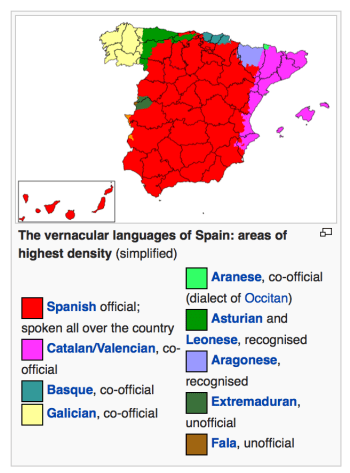
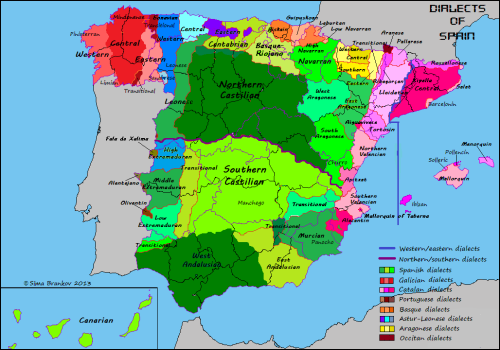
We had an interesting chat with Begonia about language (I was telling her what a relief it was to be back in a Spanish-speaking country after struggling with Portuguese). In a previous post I mentioned they speak Basque (or “Euskara”) in Pamplona. Begonia told me she understands several Spanish dialects or languages: “Gallego” or “Galician”—Galicia was the province where her father was from— and “Bable” or “Asturian,” spoken in Asturias and parts of Castille and León, where she grew up. I didn’t realize there were other dialects in Spain in addition to Basque and Catalan (which is spoken in Barcelona, Valencia and the Balearic Islands). In fact I found this map which shows there are about 10!

Screenshot 2016-02-24 15.09.06

And even those languages have differences among them. So if you want to get really detailed, the color variations below represent the variation of the language (think the difference between English in Canada and the way we speak English in the US)

dialects of spain

The next day we went for a beautiful hike to a lake in Parque Somiedo.

At one point we took a wrong turn and so had to bushwack our way down through all this shrubbery and snow!

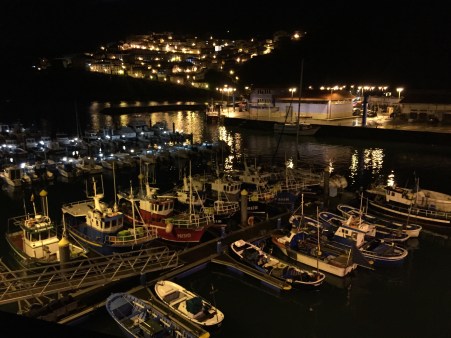
On the way to Ribadasella (in the province of Asturias), a place which was one of several circles a helpful lady in the Tourist Information office drew on our map, we stopped in some fishing villages Manuel had recommended to us. But since I’m vegetarian, we resisted the fish and took some photos instead:

IMG_7302

Cudillero

IMG_7305

Colunga

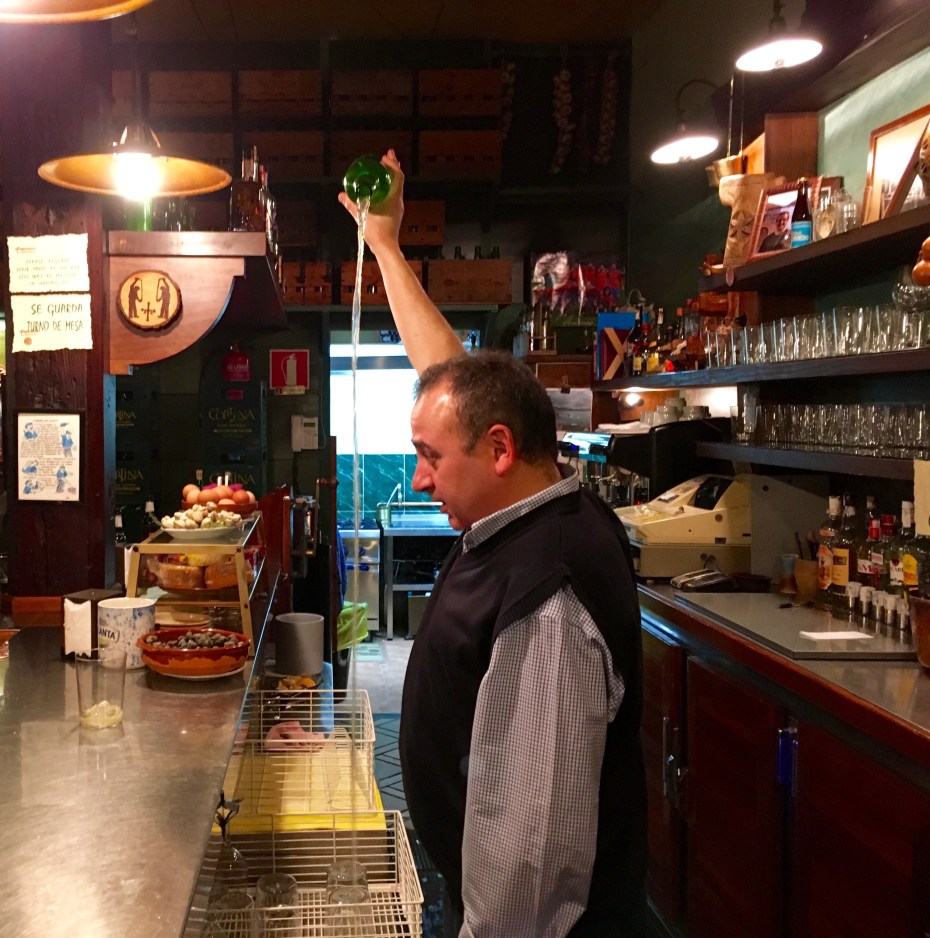
In Ribadasella we went to a “Sidreria,” which is a bar that specializes in a sparkling cider that they pour from very high up.

IMG_2030.jpg

Drinking “Cidra” is tradition in the province of Asturias. The bartenders are expert pourers.

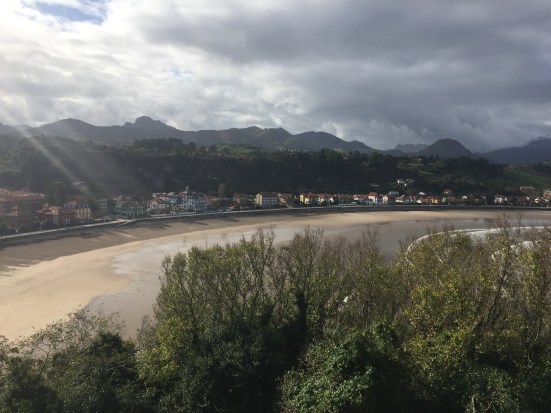
IMG_7319

The beach at Ribadasella. Too cold to swim!

IMG_2068

Taking a peak into the monastery on top of the hill in Ribadasella

I was excited to revisit the town of Llanes because I had vacationed there when I was studying abroad in Sevilla, Spain 10 years before!

IMG_7340

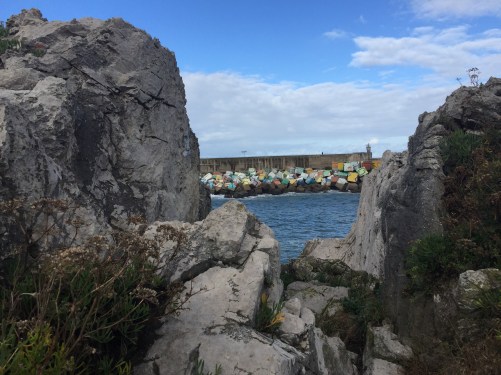
The Basque artist Augustín Ibarrola recently painted these cubes that have served as a breakwater (to protect from storms) in the Llanes harbor since the 1930’s.

More scenes from scenic Llanes-

Here David’s practicing his Fantasia moves at our next stop, San Vicente de la Barquera:

IMG_7386.jpg

fantasia1

(Sidenote: If you’ve never seen Disney’s animated film Fantasia, here’s a clip of “The Sorcerer’s Apprentice.”)

Due to many stops along the way, we realized we weren’t going to make it to our intended destination before midnight, so we changed our plans to stay with Mónica in Pamplona, who runs the AirBnb I stayed at before and after visiting Arterra.

IMG_7430

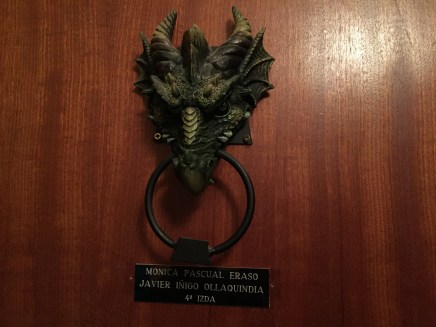
Monica’s door knocker. She also had a massive comic book collection and a bunch of medieval-looking weapons on display in her living room

IMG_7427

Pamplona is famous for the “Running of the Bulls,” which takes place during the week-long festival of San Fermines every July. Hundreds of people run through the narrow streets of Pamplona, while being chased by… you guessed it, bulls! Take my mom’s sound advice, which she dispenses anytime I go near the country of Spain: “Don’t do anything stupid like running with the bulls in Pamplona!” Mom, you will be happy to know the above is just a statue!

IMG_1486

A selection of tapas or “pinxtos,” which are especially popular in Basque Country. They are sometimes referred to as “small plates” in English menus because you order each item separately. If you eat 3 to 8 pinxtos (depending how big they are and how hungry you are!), it constitutes a delicious Spanish dinner.

I also got to take David to Pamplona’s anarchist bookstore, Katakrak, which my friends at Arterra had told me about. Anarchist bookstores contain “revolutionary” or harder-to-find titles, many of which support ideas that differ from those in popular culture. You know I love to read, and this bookstore was full of books I’d never heard of before!

The next day, I wanted to explore another place my friends from Arterra had told me about: Bardenas Reales. They said that lots of Spanish TV commercials, music videos and even TV shows and movies had been filmed there because it looked so different from the rest of the Spanish landscape:

I didn’t tell David where we were going, so he was quite surprised to find himself in a desert that was reminiscent of Arizona or Utah in the Southwest of the US.

Our last stop on our road trip, and where we would return “The Jet,” was Barcelona. A cool thing about parking in Barcelona (unlike San Francisco) is that you can pay the early morning hours of your parking meter the night before! If you tell this to an adult in San Francisco, I think they will be jealous. When we returned the Jet it had 2514 kilometers on it. Can anyone figure out how many miles that is?

IMG_7454.jpg

One of the first orders of business in Barcelona was to mail all of David’s climbing stuff that we’d been carting around in the trunk of the Jet back to the US:

IMG_2151

My friend Jon wasn’t in Barcelona this time around (read about my first stop in Barcelona- and of my entire trip- here!), but I was excited that my new friend Sophie from Arterra was there to hang out with! She’s living in a neighborhood of Barcelona called Grácia.

IMG_2155

IMG_2159

Sophie’s boyfriend works at this swanky bar called, “Les Gens Que J’Aime”- that’s actually French not Spanish… (Can you spot us?)

That’s it for Spain (for now!). Tune it to see where I’ll go next 🙂


Categories: Uncategorized | Leave a comment

A Spanish Road Trip (with a visit to Portugal)

David and I were having a hard time choosing where to go from Madrid. We decided in order to stay as flexible as possible with our plans for the next six weeks, we would rent a car and explore Spain a bit longer before we bought a flight anywhere. As a bonus, Portugal is so close by we could zip over and see a new country.

Manuel gave us lots of advice about his favorite places along our drive, and with his recommendations as our guide, we set off for our first destination: Salamanca. Along the way we stopped at the Gardens of the San Ildefonso Palace (you had to pay to go inside, but the outside was free and still very impressive. Besides we like being outside better anyway!)

We made it to Segovia at sunset, just in time to get some beautiful photos of their ancient Roman aqueduct.

IMG_1585

They had set up a stage in the plaza next to the aqueduct for student performances in honor of “El Día de los jovenes” or National Children’s Day. Speaking of things that make kids happy… some say the Castle in Segovia is the one the Walt Disney symbol is based on, but apparently that’s up for debate.

IMG_1611

We bought way too many sweets and cookies at a pastry shop next to this Cathedral in Plaza Mayor.

IMG_1618

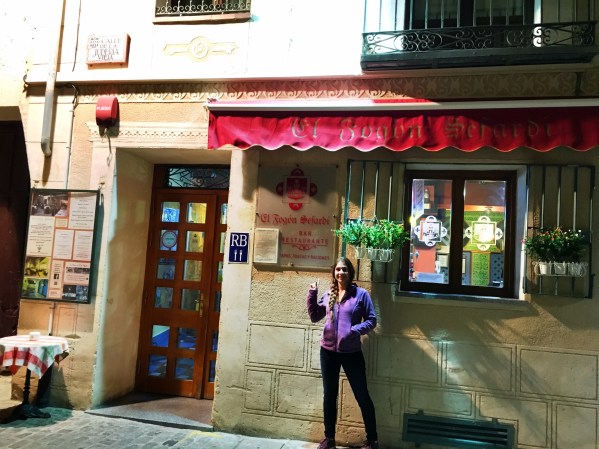
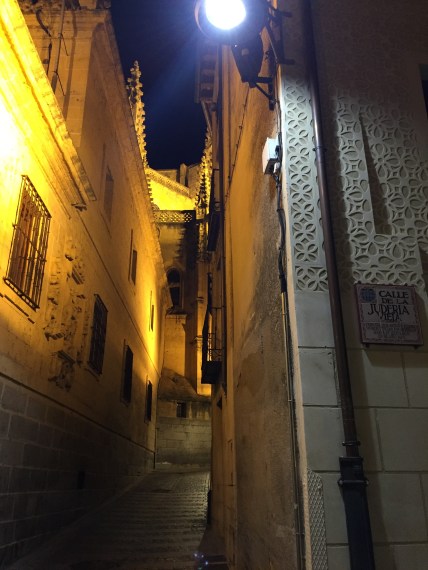
We also discovered the old Jewish quarter (there aren’t many Jewish business left here, so we had our first Pakistani food since arriving in Spain).

IMG_1612

IMG_6919

We checked into our hotel in Salamanca just before midnight. We’d had such a long day and visited so many cities, somewhere along the way we got confused and thought it was Saturday instead of Friday. Because a lot of things are closed in Spanish towns on Sunday, we thought we’d better go see what Salamanca was like on a Saturday (even though it was actually only Friday) and so we visited the busiest street, which was indeed packed!

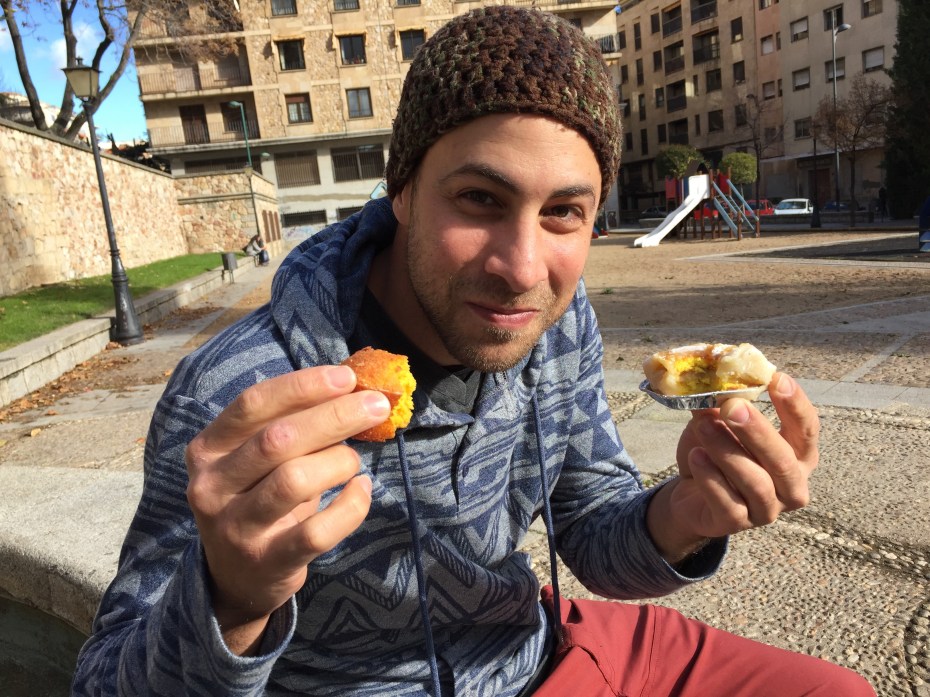
Here’s David eating the, “sweetest sweet thing I’ve ever sunk my sweet tooth into” (from Segovia) It was sweet surrounded by sweet filled with sweet.

IMG_6928

With all that sugar in his blood, we had to go for a long run. It was really cold so this was also a good way to see the city without getting frostbite.

Just before we went out to dinner that night, I talked with my dad on the phone and realized (with his help…) that it’s Saturday (again) and not Sunday like David and I thought. So we gain a whole day of our lives back! Luckily we’re able to change our AirBnb reservation in Portugal, which we made thinking we’d arrive in Porto a day later than we actually would.

Getting to Portugal was another long adventure.

Screenshot 2016-02-20 19.40.31

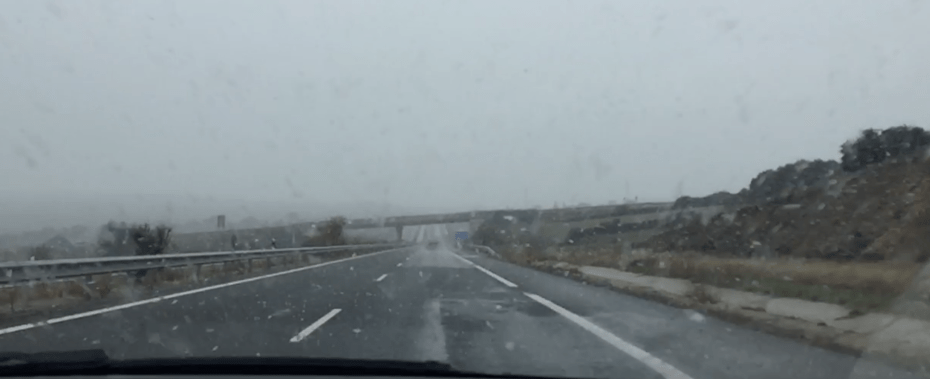
It snowed for the first half hour of the drive (our first snow sighting in Europe).

IMG_1631

One of our not-too-shabby views.

We stopped many times along the way in small medieval-looking towns like Bejar, Alberca, and Ciudad Rodrigo (where we had a picnic).

Below is another quite old-looking school. Some nearby graffiti reminded me of some of the drawings I’ve seen in student journals (although I believe it may have been done by an adult who never learned proper manners in school!)

IMG_6961

David’s museum (“museo” en español) was closed in Bejar

IMG_7023

I find my second-favorite animal in Alberca

Do things look old to you? Or kind of disneyland-ish?

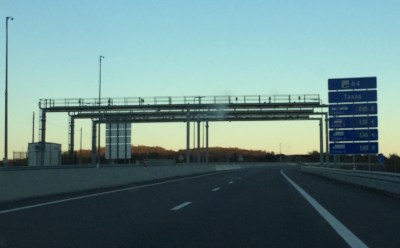
We were very confused about the tolls on the highways in Portugal. Apparently there’s a big sign when you cross the border from Spain—we saw it but weren’t sure how we felt about following it off the highway (Since it was just a big sign that said “foreigners”). We later learned “Foreigners” is where you get your “Fast Pass” to pay the electronic tolls, which look like this:

IMG_7198

If you have a Portuguese license plate, but don’t have a fast pass, you go to the post office to pay your tolls. I tried this, and had a very interesting conversation in which I spoke Spanish and the woman who worked there spoke Portuguese. The languages are fairly close, so we understood each other enough for me to learn I couldn’t pay our tolls there like everyone else does because we’d rented our car in Spain. We also couldn’t rent a Fast Pass device from them because we didn’t have a Portuguese mobile number. We could’ve called the toll company to ask their advice, but the pay phone at the Post office was broken. So no luck, but some interesting Portuguese practice!

It’s an hour earlier in Portugal than in Spain, so I got to “sleep in” my first morning (like when we turn the clocks back in the Fall). I was very excited to have my first eggs for breakfast because in Spain they pretty much just serve toast as breakfast.

IMG_1645

A technique I developed when traveling in Latin America (land of “batidos” ie scrumptious smoothies): to create the most delicious smoothie flavor, you must drink your two different flavors halfway down and then combine them.

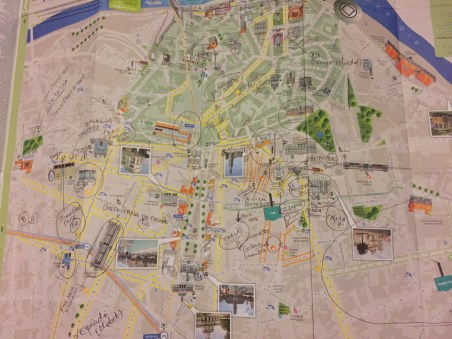
The women who owned the AirBnb where we were staying sat us down with a map of Porto and wrote in or circled all their favorite spots. So we had our work cut out for us over the next few days.

IMG_9159

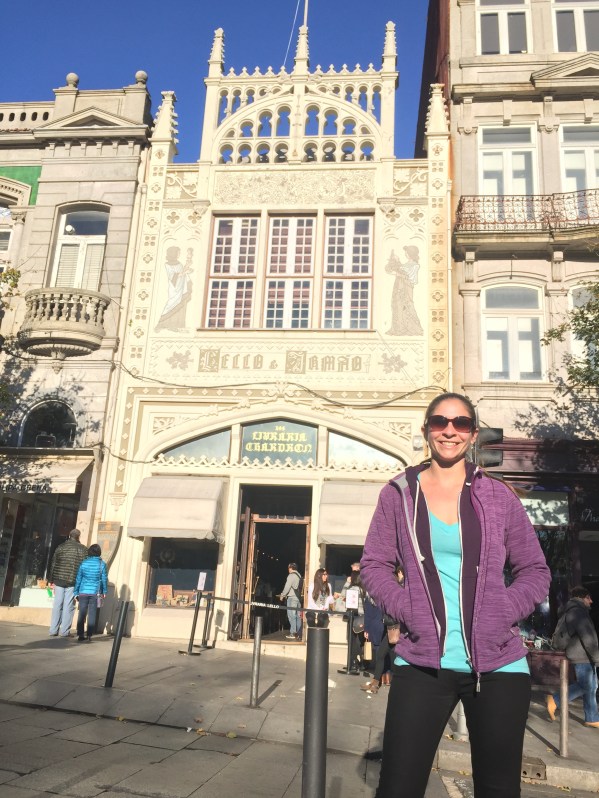
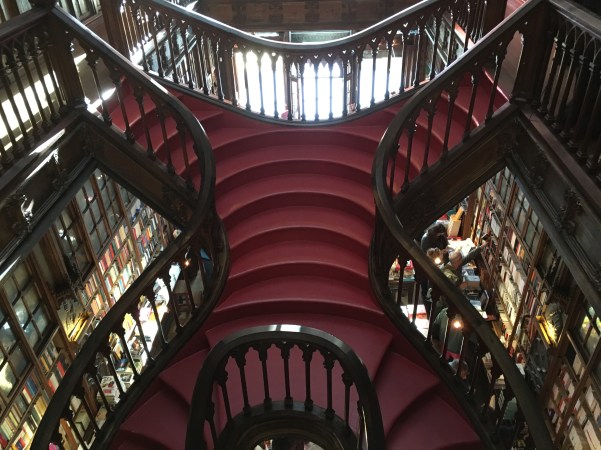
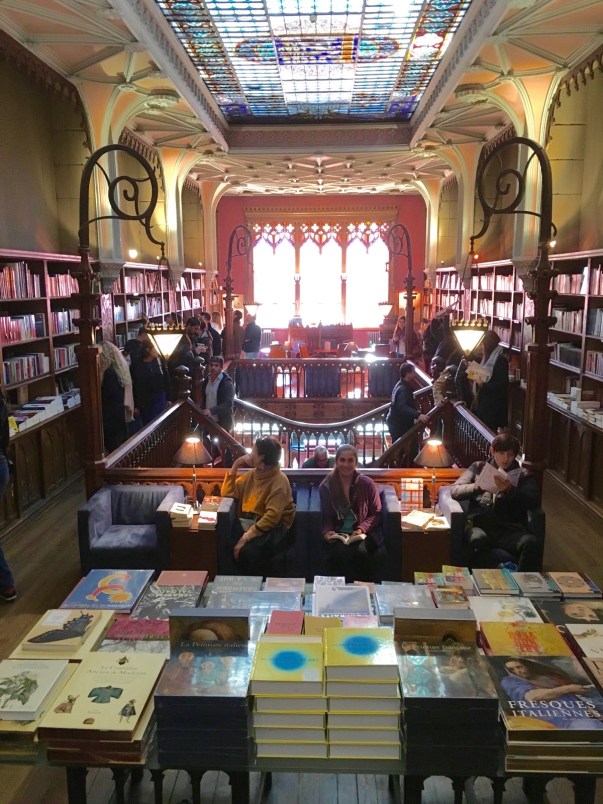
We saw Livraria Lello, one of the most beautiful bookstores in the world. It is especially famous because it was frequented by JK Rowling when she was living and teaching English in Porto. It’s said it provided inspiration for her Harry Potter books.

IMG_7048

IMG_1704

IMG_7084

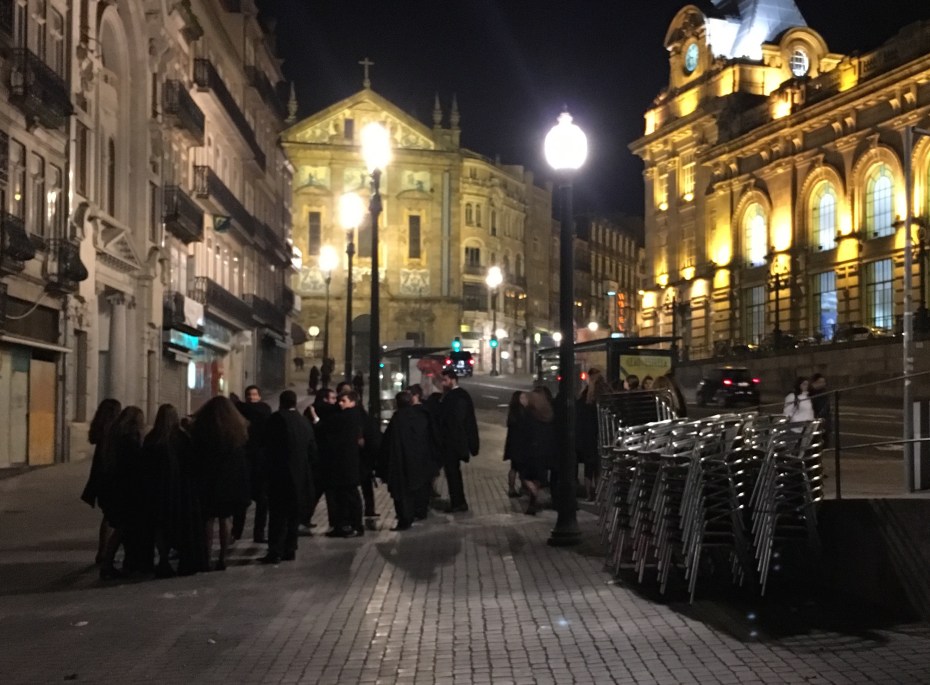
Another good example of life inspiring literature is that the students in the University of Porto wear capes very similar to the ones JK Rowling had the students at Hogwarts wear.

IMG_1761

Other sites we saw included:

IMG_1688

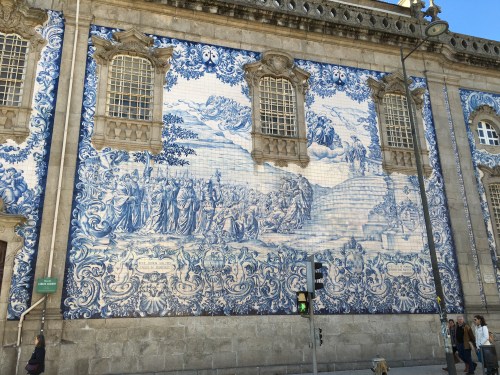
Blue and white tiled churches (Porto is known for this style)

IMG_1689

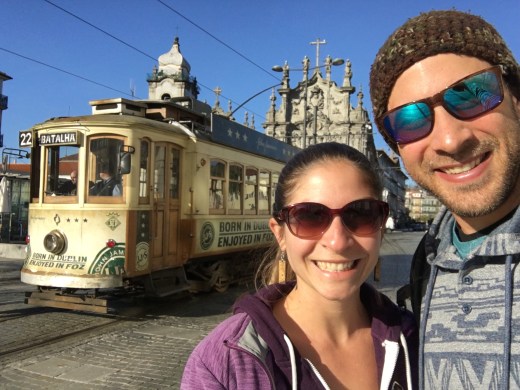
A San Francisco style trolley 🙂

IMG_7120

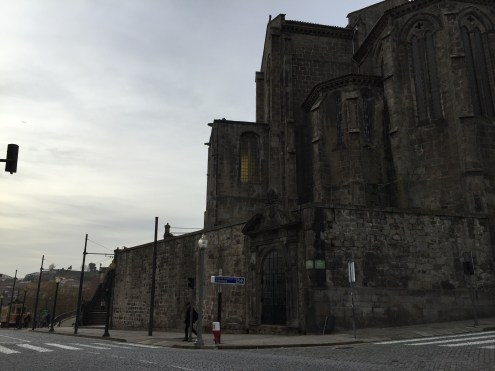
The Church of San Francisco (many churches, plazas, towns, and schools in Spain and Portugal are named San Francisco after Saint Francis of Assisi). Can you spot the trolley again?

IMG_1741

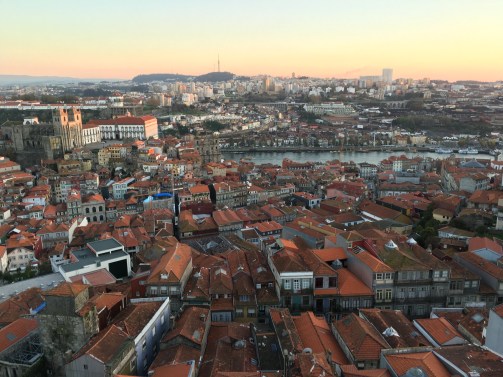
Sunset at the Clergies Church and Tower- 240 steps up to see this spectacular view!

IMG_7102

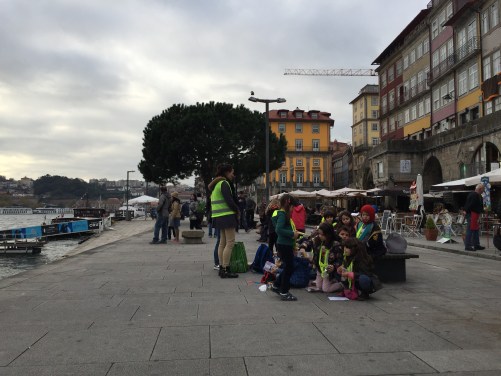
Students on a field trip. They wear the same safety vests as SFPM kindergarteners!

Da Terra, Best Vegetarian buffet of my life:

Porto storefront gets ready for wintertime and an ice skating rink goes up in one of the main plazas:

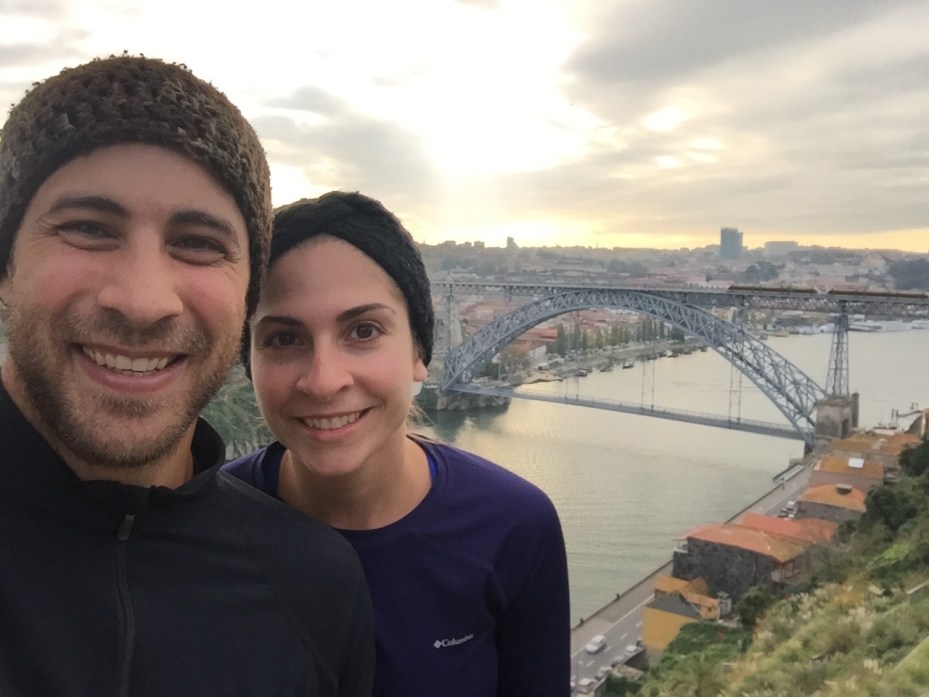
Here we are on a run down to the Maria Pia Bridge, the oldest bridge in Porto, designed in 1877 by Gustave Eiffel, the builder of the Eiffel Tower!:

IMG_7089

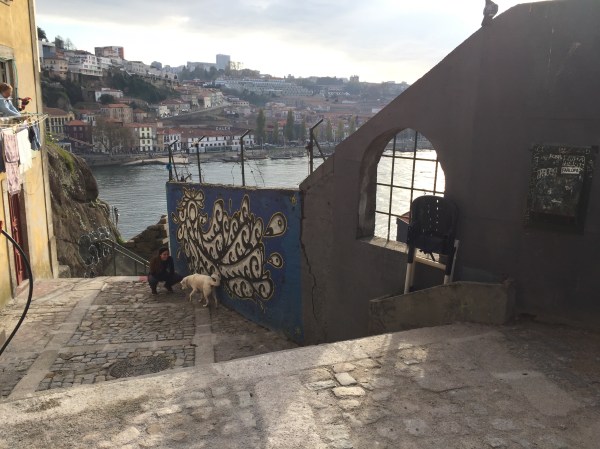
We enjoyed the colorful and often whimsical graffiti all over Porto:

IMG_7092

We also kept hearing about the specialty of Porto, called “Francesinha.” On our way out of town we stopped at a restaurant to finally sample this delicacy. Francesinha is a sandwich that originated in Porto. It is usually made with several types of meat (but I had the vegetarian version) and then it’s covered with melted cheese and a thick tomatoe-y sauce.

Maybe one of my readers will successfully recreate this delicacy! I’d certainly never seen it on a menu until I traveled to Portugal. On that note, I’ll have to save the second half of the road trip until the next post, because it’s time to go search out some dinner for myself.


Categories: Uncategorized | 2 Comments

Marvelous Madrid

IMG_6763

On Thursday, November 12th (my half birthday), I took a bus back to Madrid to meet up with a Very Important Person and my travel companion for the adventures ahead:

IMG_1362

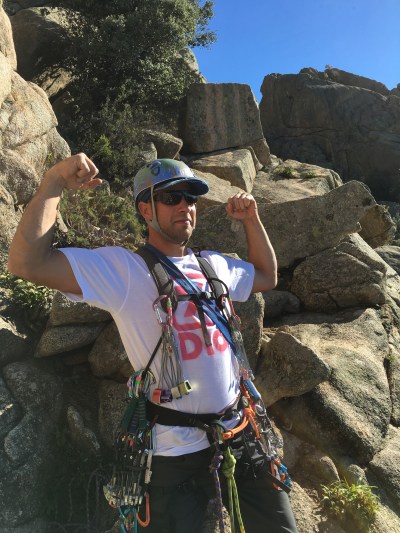
David just finished a 6-week training course for Rock Climbing Guides called “Mountain Training School.” He was climbing very difficult rock cliffs all over Spain from sun up to sundown. I was actually not jealous at all! Since David was not used to sitting or standing around we went on some long runs around Madrid to see sights and get some energy out.

IMG_6771

Retiro Park, Madrid

IMG_6803

Alcobendas, a suburb just 20 minutes outside Madrid where David’s friend Manuel lives.

I have a couple friends from college in Madrid (who’d never met each other), and we had a blast hanging out with them.

IMG_6787

Jessica, Me, Jeannette, David, & Nabil at Artemisa (delicious vegetarian restaurant near Plaza Santa Ana where Jeannette lives)

We went to “micro theater” with Jessica which consists of 6 different 20 minute plays going on at once in tiny rooms of a small house. The play we saw was about two bakers and was called “Más amas, más amasas,” which translates to “the more you love, the more you knead.”

Knead like the action you do to dough in order to mix it up and get it ready to rise nicely, but also it’s homophone “need” makes sense in that context as well. It’s my first pun in Spanish. The bakers kneaded the dough because they loved each other, but they also “needed” things from each other because they loved each other. We were literally about 5 feet from the actors.

We also went to a flamenco show at a theater called Cafetín la Quimera with Jeannette and her friend Belén who was visiting from Argentina.

I didn’t want to video during the show b/c we were right up front and I thought it would be rude, but I found plenty of other people’s videos posted online. So here is the group we saw. Something I love about Flamenco dancing (and singing and guitar!) is that you can really feel the performer’s emotions. As you can see, it takes an a lot of athleticism too!

In Madrid, I ate vegetarian food to my heart’s delight since David had been in Spain long enough not to object to a change of restaurant scene (he’s not a big fan of the large hunks of meat, soggy French fries, and fried egg common in run-of-the-mill Spanish restaurants). Madrid has about 50 vegetarian restaurants and I think we sampled about 1/6 of those!

IMG_6839

When we stayed at Manuel’s house we did some of our own cooking too (for him and lovely Carmen):

IMG_6812

Manuel is a Physical Therapist and regaled us with tales of his rich and famous clients. One of my favorites: he taught a 14 year-old who’d been a bit too pampered his whole life, how to safely jump from his living room couch to the floor.

IMG_6831

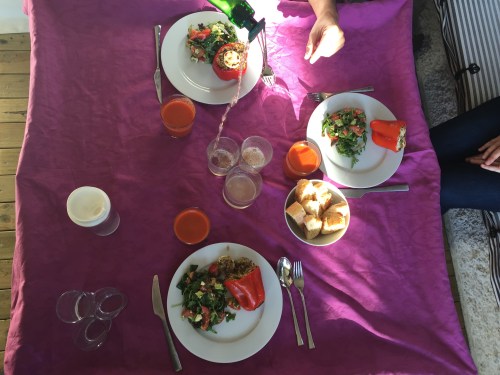
Here is a lunch we made: Gazpacho, Salad, Honey-vinegar quinoa, Goat cheese and vegetable stuffed peppers. Manuel poured us cider the fancy high-up way (Asturias in the north of Spain is famous for this- I’ll make sure to get a photo of it when I reach the North!)

IMG_6819

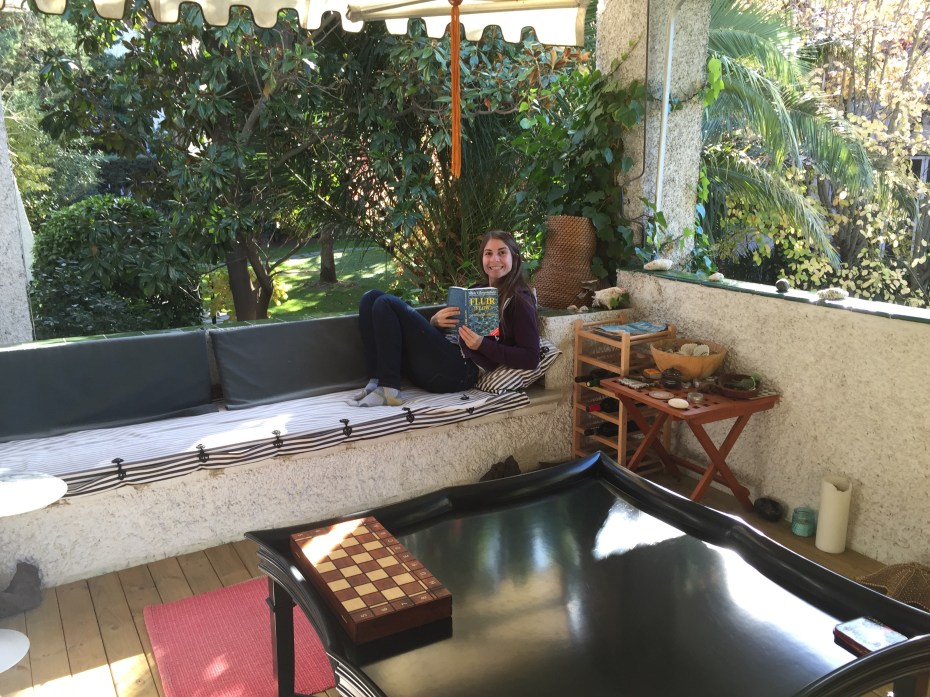
I found this book, “Fluir,” or “Flow” in English, by psychologist Mihaly Csikszentmihalyi (that’s Zofia’s grandfather!) in Manuel’s bookshelf–proof of its international popularity 🙂 

Manuel and Carmen toured us around Madrid, including bringing us to Parque del Oeste which has a real Egyptian temple.

IMG_1464

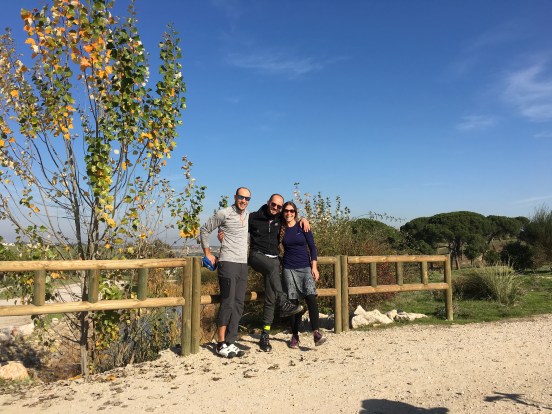
Manuel took us on an epic bike ride into Madrid from his town, Alcobendas. Luckily he had extra bikes (although my seat was too high so I learned the word for allen wrench in Spanish:, “juego de allen” since we asked every biker who passed us if they had one).

IMG_1488

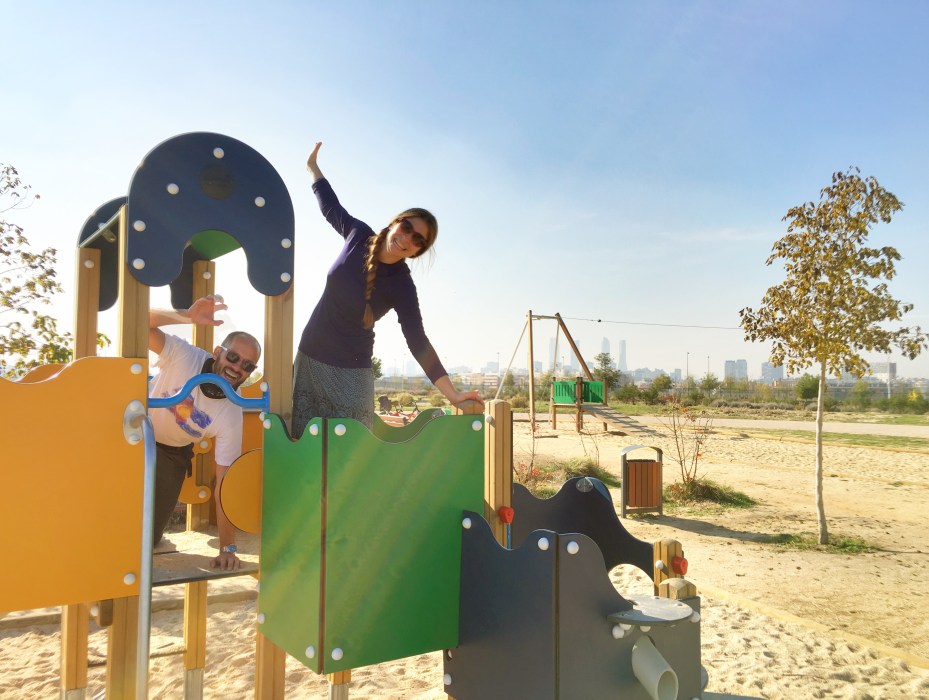
Manuel explained that for every new housing complex that goes up they have to build a park. I’d never seen a park with such tiny trees. Check out the “buena vista” (good view):

IMG_1502

IMG_1508

Playing around in the park with a view.

Pollution in Madrid can get so bad that they limit the number of cars driving into the city according to license plate.

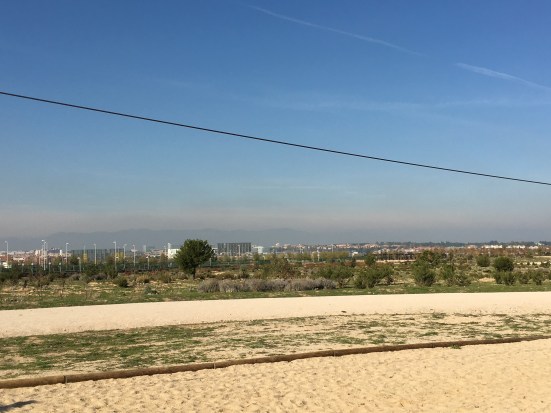
IMG_1509

Manuel says on a good day, you can see the mountains perfectly. Notice how hazy they were looking during our adventure. That’s smog 😦

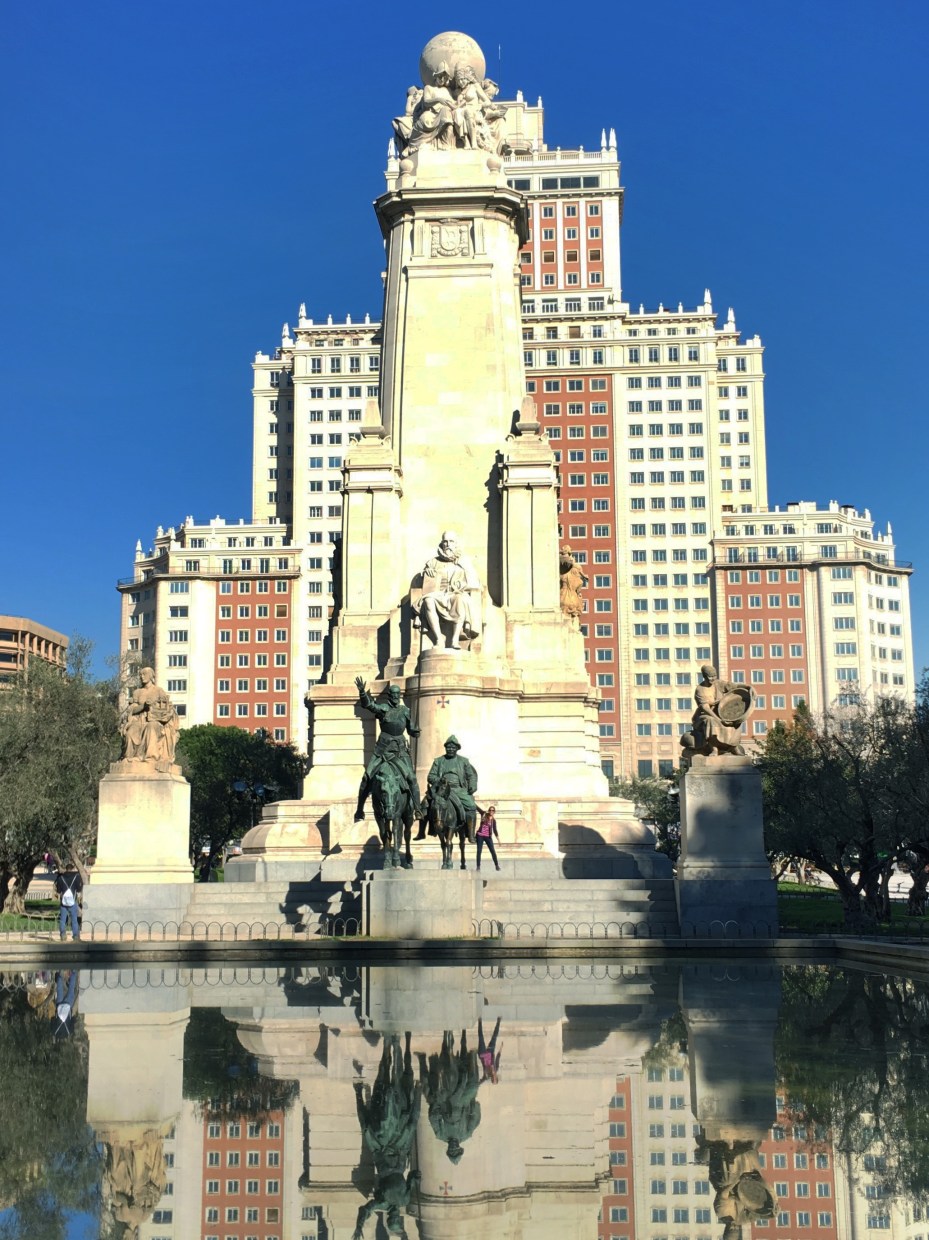
Luckily there are parks for respite.  In addition to Parque Retiro, Casa del Campo is an enormous park in the East of Madrid. We walked there one day from the Plaza de España, pictured here:

IMG_1529

Me with Don Quixote and Pancho Villa

A couple last things about Madrid (actually Spain in general):

IMG_6776

There’s lots of plazas- public squares- where people gather, and where you can always find kids playing soccer

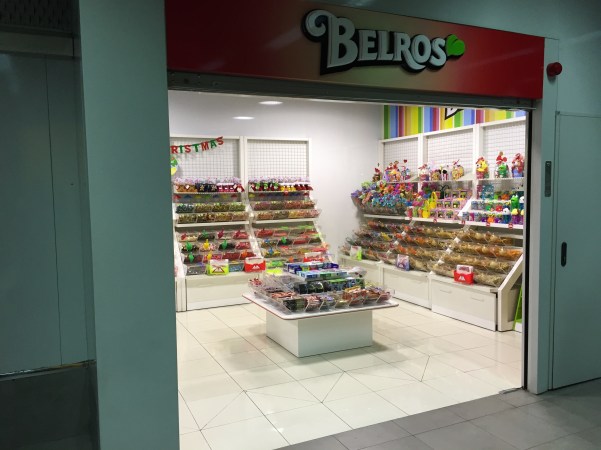
IMG_6834

There are candy stores everywhere! Spaniards seem to especially love gummy candies. This shop is underground in the metro.


Categories: Uncategorized | 3 Comments

Lakabe Ecovillage

My account of my time at Arterra would not be complete without mentioning the trip I took with Linda and Jesus to visit a neighboring community (30 minute drive away), called Lakabe. Lakabe is a famous (and fantastic!) example of an “Ecovillage.” The “Eco” because it consists of people who have chosen to live together in a way that is harmonious with nature, such as building their homes with sustainable materials and using less electricity and water. The “village” because it is only through their combined efforts and family-like teamwork that they are able to live comfortably using far less energy, money, and material possessions.

Notice the solar panels, wind turbines, and hand-chopped wood. Also, the beautiful natural surroundings!

At Lakabe, it turned out there was a Montessori School too! Recognize anything?

The story of how the community of Lakabe came to be is very interesting! If you’d like to learn more, read this great description written by Bay Area native Andri Antoniades in the online news magazine “Take Part”:

Forget greening your home and just ditch it altogether. In Lakabe, Spain, a group of adventurers did just that. After accidentally stumbling upon the remains of a medieval ghost town in the Spanish countryside, about 20 settlers left their urban existences and claimed the ruins as their own, turning it into a self-sustaining mini-society built upon eco-friendly principles.

FairCompanies visited the site and spoke to Mauge Cañada, one of the original pioneers of the Lakabe settlement.

Lakabe was a remnant from the medieval age that remained inhabited until sometime in the 1950s. Rediscoverd in the 1980s, the settlement has since evolved into a well-organized society, based on principles that allow residents to maintain a rich quality of life while taking care of the the earth they use. 

According to Cañada, the first few years were especially difficult; the town’s settlers brought with them almost no knowledge of ecology or country living. Initially they depended on oil lamps and candles for light and spent their nights crammed into the same one-room structure because it was the only one on the property with an intact roof. Without any money or even roads leading back to civilization, the Spanish government left the group alone, sure that they would quickly give up and get out. That never happened.

Lakabe’s present-day incarnation is nothing like its rough and tumble past. Gone are the oil lamps and candle-lit evenings; instead villagers make their own energy from windmills, solar panels and a water turbine.

And instead of the communal sleeping area, energy-efficient family homes sit tucked into the hillside, resurrected from the rubble with the help of locally-sourced materials; this includes lumber, taken from the surrounding trees that villagers regularly reseed, ensuring their forest is never depleted.

There’s even an organic bakery. Loaves of sourdough bread produced in Lakabe are so popular they provide a small but steady stream of revenue for the village that makes working outside of it unnecessary.

And when residents don’t want bread, they can enjoy a steady supply of fruits, vegetables and poultry located just outside their front doors.

“There’s an austerity that’s part of the desire of people who come here,” explains Cañada. “There’s not a desire for consumption to consume. We try to live with what there is.”

But what may be more surprising about Lakabe is that it is not entirely unique. Other settlements of similar principle, referred to as ecoaldeas, have shown up along the Spanish countryside. Resettled towns like Matavenero-Leon and Huesca have evolved into self-contained communal villages. In them, work and its rewards are shared and performed in accordance with a set of principles that remain steadfastly in support of nature.

Though self-contained eco-villages may not be a probability for U.S. residents, the principles behind them are universal: Take only what you need, replace what you use, and the planet will provide.

Categories: Uncategorized | 1 Comment

Blog at WordPress.com.