My account of my time at Arterra would not be complete without mentioning the trip I took with Linda and Jesus to visit a neighboring community (30 minute drive away), called Lakabe. Lakabe is a famous (and fantastic!) example of an “Ecovillage.” The “Eco” because it consists of people who have chosen to live together in a way that is harmonious with nature, such as building their homes with sustainable materials and using less electricity and water. The “village” because it is only through their combined efforts and family-like teamwork that they are able to live comfortably using far less energy, money, and material possessions.


Notice the solar panels, wind turbines, and hand-chopped wood. Also, the beautiful natural surroundings!
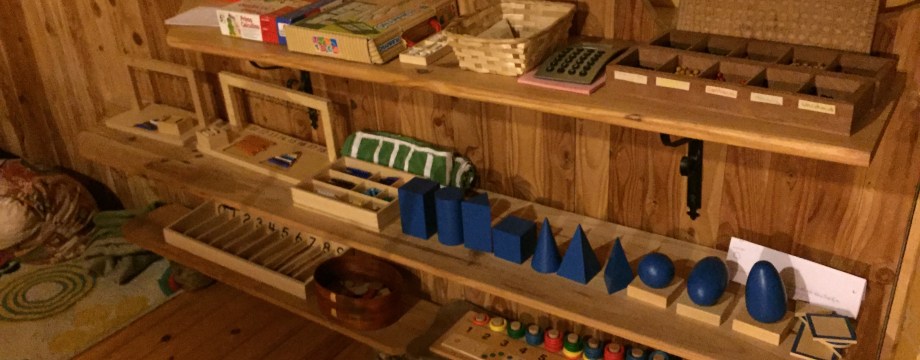
At Lakabe, it turned out there was a Montessori School too! Recognize anything?


The story of how the community of Lakabe came to be is very interesting! If you’d like to learn more, read this great description written by Bay Area native Andri Antoniades in the online news magazine “Take Part”:
Forget greening your home and just ditch it altogether. In Lakabe, Spain, a group of adventurers did just that. After accidentally stumbling upon the remains of a medieval ghost town in the Spanish countryside, about 20 settlers left their urban existences and claimed the ruins as their own, turning it into a self-sustaining mini-society built upon eco-friendly principles.
FairCompanies visited the site and spoke to Mauge Cañada, one of the original pioneers of the Lakabe settlement.
Lakabe was a remnant from the medieval age that remained inhabited until sometime in the 1950s. Rediscoverd in the 1980s, the settlement has since evolved into a well-organized society, based on principles that allow residents to maintain a rich quality of life while taking care of the the earth they use.
According to Cañada, the first few years were especially difficult; the town’s settlers brought with them almost no knowledge of ecology or country living. Initially they depended on oil lamps and candles for light and spent their nights crammed into the same one-room structure because it was the only one on the property with an intact roof. Without any money or even roads leading back to civilization, the Spanish government left the group alone, sure that they would quickly give up and get out. That never happened.
Lakabe’s present-day incarnation is nothing like its rough and tumble past. Gone are the oil lamps and candle-lit evenings; instead villagers make their own energy from windmills, solar panels and a water turbine.
And instead of the communal sleeping area, energy-efficient family homes sit tucked into the hillside, resurrected from the rubble with the help of locally-sourced materials; this includes lumber, taken from the surrounding trees that villagers regularly reseed, ensuring their forest is never depleted.
There’s even an organic bakery. Loaves of sourdough bread produced in Lakabe are so popular they provide a small but steady stream of revenue for the village that makes working outside of it unnecessary.
And when residents don’t want bread, they can enjoy a steady supply of fruits, vegetables and poultry located just outside their front doors.
“There’s an austerity that’s part of the desire of people who come here,” explains Cañada. “There’s not a desire for consumption to consume. We try to live with what there is.”
But what may be more surprising about Lakabe is that it is not entirely unique. Other settlements of similar principle, referred to as ecoaldeas, have shown up along the Spanish countryside. Resettled towns like Matavenero-Leon and Huesca have evolved into self-contained communal villages. In them, work and its rewards are shared and performed in accordance with a set of principles that remain steadfastly in support of nature.
Though self-contained eco-villages may not be a probability for U.S. residents, the principles behind them are universal: Take only what you need, replace what you use, and the planet will provide.
 handshakehighfivehug
cool like it
LikeLike